Signal & Response: Music that connects. Artists who keep the conversation going.
I found Die Shiny because Callie Crofts turned a Facebook ad into a piece of personality. It did not feel like a generic instruction to stream a song. It showed me the wit, force and candor I might find in the music. The ad did its job. I went to listen.
What stayed with me was the continuity between the ad and the songs. The attitude did not feel invented for the promotion. The same humor, directness and refusal to soften what Crofts believes kept appearing in the work and in the band’s public history. That consistency is what made me want to know how the act became what I was hearing.
I started with Glory, the six-song EP Die Shiny released in 2025. I added “No Place” and “Bottom Feeders” to the Signal & Response playlist, then added the 2026 single “Gold Star, Good Citizen.” I love all six songs on Glory, but this is not going to be a track-by-track review. Once I began looking into the people behind the record, the history became the larger story.
That story reaches from a song written after an abortion-fund benefit to a twelve-year-old in rural Idaho finding a first instrument and a way to live with grief. Between those points are a solo record, a viral cover, international travel, a family band, My Fair Fiend, parallel work in MOWTH, two crowdfunded releases, a pandemic, years of home production and a creative partnership that was already old when Die Shiny began.
To see how those pieces became the current act, we will work backward.
The attitude did not stop when the ad ended
The Facebook ad was a performance, but the personality was not a temporary marketing character. The same combination of humor, confrontation, self-awareness and concern for other people keeps turning up in Crofts’ lyrics and in the way Crofts speaks about the band’s history.
In “No Place”, the voice moves between severe self-judgment and exaggerated self-belief without pretending those positions fit neatly together. The writing places the speaker inside both the joke and the problem. That resembles the attitude in the ad: confident enough to command attention, but too self-aware to perform spotless certainty.
“The Fountain” turns the language of wealth and business into satire. The humor does not replace the political position. It is how the position is delivered. That correlation becomes clearer beside Crofts’ later interviews, where they describe becoming less afraid of being openly fiery and political even after friends warned that such directness could hurt the band.
“Random Switch” carries the same personality into questions about consciousness, chance, divinity and human connection. The subject changes, but the stance remains recognizable: skeptical of easy certainty, attracted to large questions and still willing to be playful inside them.
In “Gold Star, Good Citizen”, ordinary routines lead into institutional power and shared responsibility. The writing does not leave the singer safely outside the problem. That willingness to include oneself in the accusation matches Crofts’ public mixture of conviction and suspicion toward anyone claiming complete purity.
Taken together, the songs carry a consistent public attitude: amused by human absurdity, candid about contradiction, protective toward vulnerable people, distrustful of authority and unwilling to soften a belief merely to make it easier to market. Every narrator does not have to be Crofts speaking literally for that character to come through.
2026: good citizens, bad systems and a band moving outward
Die Shiny’s newest release is “Gold Star, Good Citizen”, dated July 3, 2026. It became the third Die Shiny song I placed on Signal & Response, but the story of how it reached the playlist begins away from a studio.
In an August interview with CHARMMusic, Crofts traced the song to a Utah Abortion Fund benefit. The entire song arrived the following day, and the band moved quickly to prepare it for a political march. Friends contributed the stomps and claps used in the recording. Within days, according to Backseat Mafia, Die Shiny performed it at a protest on the steps of the Utah State Capitol.
That rapid path from benefit to writing session to public protest fits the way Crofts says songs sometimes arrive. In a Mystic Sons interview, Crofts described keeping a phone full of fragments and dropping everything long enough to capture an idea when it appears. On rarer occasions, a complete song comes in one sitting. Crofts calls that a “song attack” because it feels less like a scheduled writing session than something happening to them. “Gold Star, Good Citizen” was one of those moments.
The song also shows how Die Shiny’s activism now moves through several forms at once. There was a benefit, a march, a recording made with friends and an official video directed by Ryan Margetts. In Promonews’ production account, the video places Crofts and blindfolded dancers inside individual white picket fences. Each part gave the same public concern another place to be seen.
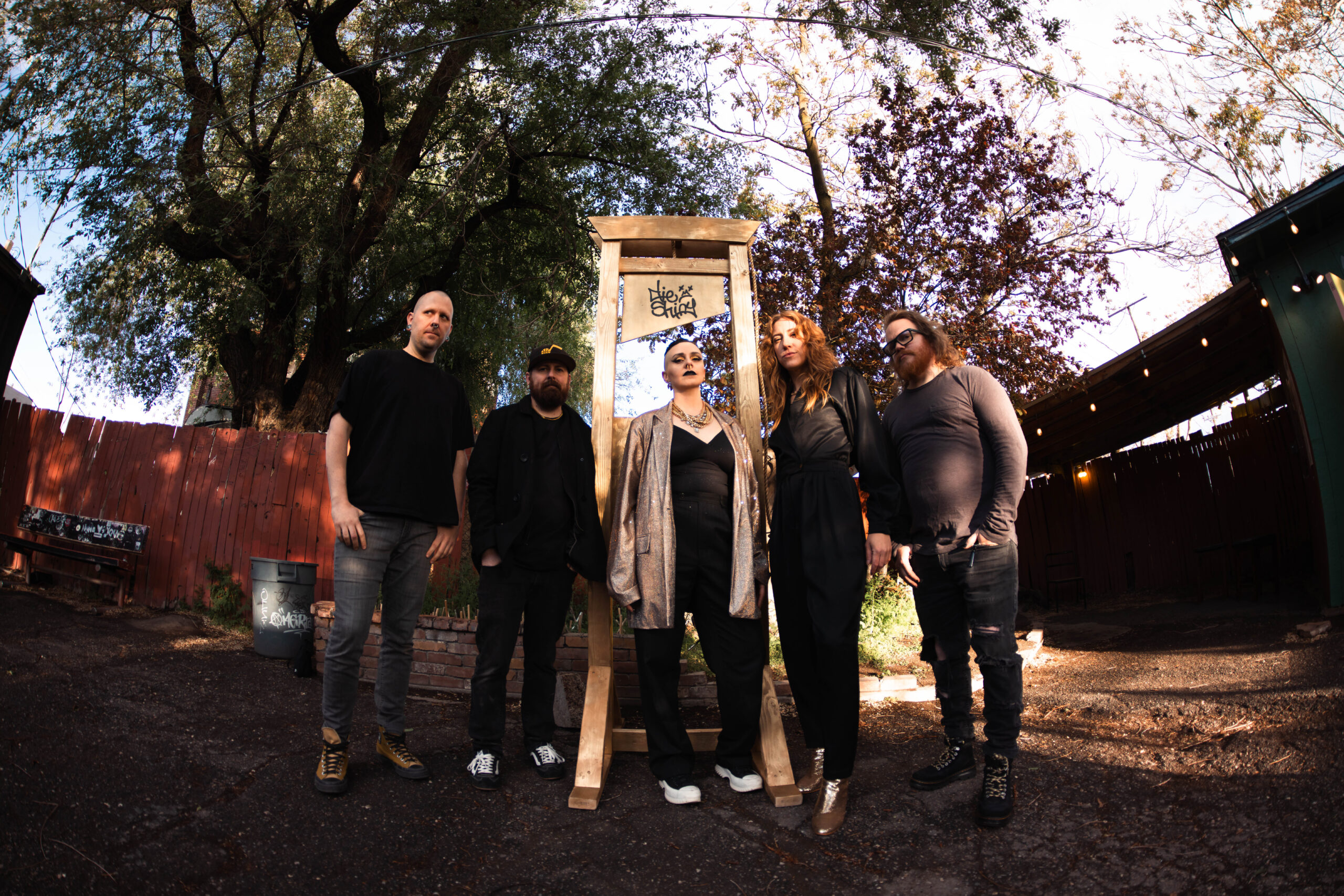
In June, SLUG Magazine described Die Shiny as a studio partnership between Crofts and drummer, engineer and producer Zac Bryant, expanded onstage by guitarist Matt Wiley, keyboardist and vocalist Caleb Wall, and vocalist Carolyn Schmitz. Crofts and Bryant produce the records. The five-person lineup carries the work into live rooms. Die Shiny is both a long-running two-person production partnership and a current live ensemble.
The same SLUG profile records how that public identity acquired a name. A listener approached Crofts and suggested “conscious pop.” The band adopted the phrase, while Crofts described the project more broadly as electropop with a punk ethos. More significant than the genre label was the exchange itself: a fan supplied language the band recognized as true.
By then Crofts was no longer willing to separate the work from a political position. They told SLUG that some listeners and friends had warned that open politics could damage the band’s prospects. Crofts accepted that risk. The interview also connects the band’s development to Salt Lake City’s queer community, which Crofts said had helped the music evolve and sharpened a commitment to making performances feel safe for queer, introverted and neurodivergent listeners.
Independence is part of that commitment. Crofts and Bryant self-produce, and Crofts has been learning digital marketing rather than turning the work over to a conventional label system. It is an unglamorous part of the timeline, but a revealing one. The Facebook ad that first reached me was not separate from the band’s story. It was evidence of Crofts learning how to build an audience without surrendering the project.
As I write this on September 24, Die Shiny has six regional dates listed from September 28 through October 4, moving through Missoula, Spokane, Bellingham, Portland, Boise and Salt Lake City. The route marks a band carrying the current work beyond its home city.
The band’s official shop points in the same direction. It currently lists preorders for a “Gold Star, Good Citizen” seven-inch record and a Gold Star, Good Tour live album. The regional dates, physical single and live recording place Die Shiny in a transitional moment: a home-production partnership is documenting what happens when its work reaches shared public spaces.
I still want to know whether “Gold Star, Good Citizen” stands alone as a response to this moment or opens the next larger Die Shiny project. That question belongs in the conversation still to come.
Even the name carries history. In the CHARMMusic interview, Crofts connected Die Shiny to the human ego, the tragedy and comedy of being alive, and the absurdity of taking ourselves too seriously. An earlier City Weekly interview described the project as a place where darkness and fun could coexist. The name was built to hold both.
2025: Glory, wider recognition and a public community role
Die Shiny held a release show at Salt Lake City’s Urban Lounge on April 11, then released Glory on April 25. Its six songs are “No Place,” “The Fountain,” “Chrysalis,” “Embalmed,” “Bottom Feeders” and “Random Switch.” The release carries a Nine Moon Records credit and was self-produced by Crofts and Bryant.
The production arrangement was not merely a studio preference. By 2025, Crofts was speaking publicly about avoiding a conventional label relationship and learning the business skills necessary to keep control of the work. That makes Glory a useful point on the timeline: it joined years of creative independence to a more deliberate effort to operate independently as a business.
The year also brought a new level of public visibility in the band’s home community. Die Shiny appeared on KRCL’s RadioACTive in June during a program highlighting local music and events created for people marginalized by patriarchy. Later that month, the band received the 7:20 p.m. headlining slot on the SLC Pride stage. QSaltLake placed Die Shiny on its Pride issue cover and described the act in terms of queerness, activism and volume rather than treating identity as a footnote.
The visual work traveled beyond ordinary release promotion. Ryan Margetts’ video for “Embalmed” screened through FilmQuest’s 2025 program and later received the virtual Best of Fest audience award from the Utah Queer Film Festival. The video and the live appearances put the band’s work into film, Pride and community spaces during the same year.
In December, SLUG Magazine included Glory among its five albums of 2025. That recognition belongs on the timeline as a local career marker. My own response does not need the help.
My own response is simpler. I added “No Place” and “Bottom Feeders” to Signal & Response, and I love the complete EP. Those choices explain why I began the research. The history explains why this feature became larger than a music review.
2024: sex, sacrament and an openly political turn
The six-song Sex EP arrived January 19, 2024. Its track list is “Healthy Sex Drive,” “Undertaker,” “Ridiculous Positions,” “Two Exes,” “House That Killed Me” and “Sacrament.”
In a City Weekly feature published as the release approached, Crofts described Sex as the most intimidating part of a larger planned series. The subject connected directly to growing up in a small, rural and conservative religious setting shaped by rules and shame. Crofts named confidence, empowerment, liberation and gender dysphoria as parts of the project. Bryant added that some of its songs had existed since the earliest conversations about Die Shiny.
That long gestation is visible in “Healthy Sex Drive.” Crofts has said the song went through years of rewriting while they tried to find the vocal approach it required. The single had appeared in August 2023, but it became part of a larger statement when Sex arrived five months later.
The February 1 release show at Urban Lounge carried another kind of significance. City Weekly reported that pandemic conditions had curtailed Die Shiny’s opportunities to perform. In the band’s later Apple Music notes, Crofts and Bryant remembered the Sex release show as the first time a full venue sang every song back to them. After years of disrupted performance and home production, the audience had become audible.
The official video for “Sacrament” became a separate career marker. Its production credits name Margetts as director and director of photography, with Crofts also credited for wardrobe and makeup. The video won Best Music Video at FilmQuest in 2024 and at the Utah Film Festival in 2025.
Later in 2024, Die Shiny released “Chrysalis” on June 21 and “The Fountain” on October 25. Crofts later identified “The Fountain” as the first time they were openly and admittedly writing about politics. That decision frightened them. Some listeners were uncomfortable, and friends warned that the band might be damaging its prospects. Crofts chose to continue. The single marks the moment the project accepted the career risk of stating its politics without disguise.
2023 and 2022: home-studio growth and another band alongside it
“Healthy Sex Drive” first appeared as a single in August 2023. Provo Music Magazine described Crofts and Bryant building the track in their home studio, with Bobby St. Mute contributing trumpet. That account captures the working model that would carry into Glory: the central partnership producing at home, then bringing in another musician when a song called for it.
“Undertaker,” released in 2022 and later included on Sex, belongs to this bridge. By then, Crofts and Bryant were also working in MOWTH, a Salt Lake City group formed in 2019 by Rachel and Jordan Clark. MOWTH’s Bandcamp biography says Crofts joined on bass and Bryant on drums soon after the band’s formation. A 2022 SLUG profile described the group’s 1990s punk and grunge frame and its own music about life after leaving the LDS Church.
MOWTH is a parallel collaboration, not an earlier name for Die Shiny. Its place in this history shows that Crofts and Bryant did not move through a neat succession of projects. They continued working with close friends in a full-band setting while building Die Shiny in their home studio. The same two people could be a rhythm section in one room and the complete production center of another act.
2020 and 2019: Drugs, a pandemic and the first Die Shiny release
Die Shiny’s first EP, Drugs, arrived in October 2020 with “Bleed,” “Try Not to Think,” “Medicine,” “Heartache & Bacardi,” “Designer Drug” and “Lungs.” City Weekly reported that a Kickstarter helped fund the record and that the pandemic shaped the conditions around its arrival.
The timing made the achievement complicated. A listener-funded project had reached release just as live opportunities were disappearing. An audience helped Crofts and Bryant finish the work. Then the pandemic removed much of the public life that should have followed it.
Crofts and Bryant had been moving toward Die Shiny before the EP. City Weekly dates the point when they began devoting their musical energy to the project to 2017. The first public Die Shiny release, “Radio,” followed on August 16, 2019. That distinction helps reconcile two dates used in current biographies: the creative transition began in 2017, while the released band identity is commonly dated to 2019.
Crofts told City Weekly that Die Shiny began because the pair needed room for feelings they had not been able to express in earlier projects. They also imagined the releases as connected parts of a larger concept. Drugs would be followed by Sex, with grouped songs forming a broader whole rather than isolated campaigns.
The name and the project were new. The working relationship was not.
2017 to 2013: My Fair Fiend and the darker full-band chapter
Before Die Shiny, Crofts and Bryant were part of My Fair Fiend. The group’s Apple Music biography dates its formation to May 2013 and its last show to early 2017. Its catalog includes a self-titled 2013 release, the 2014 single “Ka-Bar” and the 2015 album Making Monsters.
An artist-supplied historical biography gives the formation a more personal context. It describes My Fair Fiend as an artistic reincarnation after Crofts emerged from a turbulent divorce and stopped shaping the music around an image they felt expected to fit. The new band represented more than a change in instrumentation or name.
Making Monsters gives a detailed picture of the group. Crofts is credited with vocals and guitar, Bryant with drums and vocals, Austin Cross with guitar, piano, organ and harmonica, and Kyle McCann with bass and NS Stick. Crofts wrote most of the songs and is also credited for production, album design and photography. Giles Reaves recorded, mixed and mastered the record.
The credits show that Crofts’ role was already wider than fronting a band. Songwriting, production and visual presentation belonged to the same creative practice. Bryant was already the rhythmic and vocal partner who would continue into Die Shiny.
Provo Music Magazine’s contemporary account reports that most of Making Monsters was tracked live, apart from Crofts’ guitar. The method placed the group in a room together and preserved the ensemble performance rather than constructing the album one isolated part at a time.
The band’s own historical biography says a Kickstarter funded the album in May 2015. It also records performances connected to Pride events. Two patterns were already in place: listeners helped finance ambitious recording projects, and queer community spaces were part of the public work.
My Fair Fiend played its last show in early 2017. That same year, Crofts and Bryant began directing their musical energy toward Die Shiny. It was not the beginning of their partnership. It was the point when years of writing, performance, production and shared decision-making took a new name.
2014 and 2010: family music, a solo record and a production partnership
In 2014, Crofts also formed the Crofts Family Band. Its current Spotify biography describes a family harmony tradition involving Callie, their father Vince, siblings Adam, Colette and Devri, and Bryant as drummer, engineer and co-producer. The biography also says Sparrow in the Birch reached the top ten on two Billboard charts.
That family project was not a sudden beginning. A 2014 Idaho State Journal profile described Crofts growing up in Firth, Idaho, with a father who played bluegrass in the Wild Coyotes. The occasion for the story was a return home: My Fair Fiend was scheduled to headline a Relay for Life benefit at Firth High School, with proceeds supporting cancer research.
The setting made the show intensely personal. Crofts’ mother had died from breast cancer when Crofts was eight. The 2014 article says Crofts had previously performed at the school alone, but this would be the first hometown appearance with My Fair Fiend. A project born from personal upheaval was returning to the place where Crofts had first encountered both music and loss.
Crofts’ solo album Zen Garden appeared in 2010. An earlier UVU Review account connected that solo work to an acoustic folk identity before the move into rock. Historical artist biographies also describe a Beatles cover video finding a much larger online audience and encouraging Crofts to pursue music more seriously.
The historical biography says Crofts released Zen Garden without an established audience while living in Utah Valley, working part time and trying to make music a sustainable life. After the Beatles cover reached a much larger online audience, Crofts traveled for music from Utah to Los Angeles and Singapore. The audience was already expanding beyond the local scene.
Crofts and Bryant’s partnership reaches back into that same period. A public production page for Robyn Cage’s Black Friday project identifies them as the team behind Nine Moon Audio and says they had been creating together since 2010. On that project they are credited with music production, orchestration and arranging. Current Die Shiny releases carry a Nine Moon Records label credit. The current production independence grew from years of making records together for their own projects and for other artists.
Before the catalog: Firth, family, loss and a first song
Crofts grew up as the youngest of five children in Firth, Idaho. The family home was full of music. Their father, Vince, played bluegrass and western swing, and Crofts later remembered falling asleep to the sound of his band rehearsing while crickets sounded outside. Older siblings brought other eras and genres into the house.
That childhood also contained an early loss. Crofts’ mother was diagnosed with breast cancer when Crofts was born and died eight years later. In the 2014 Idaho State Journal interview, Crofts said the experience made them a deep-thinking child and weakened the sense of invulnerability children often carry. Music became a way to express emotions that were otherwise difficult to place.
At twelve, Crofts followed an admired older brother into bass. A few months later came guitar and a first song. Bass was not a late addition to Die Shiny. It was the first instrument Crofts chose. Guitar became the main writing tool for years, then Crofts returned to bass and began building the songs that became Die Shiny.
The Mystic Sons interview places the scale of that practice in perspective. Crofts said they have written hundreds of songs since twelve and rejected the idea that songwriting depends on a magical visit from inspiration. It is a skill developed through repetition, including the willingness to finish imperfect work and begin again.
The same interview explains what success now means to Crofts. The most rewarding moment is seeing that a listener feels recognized and held during a performance, especially when that listener is a queer young person. That answer joins the beginning of the timeline to the present. A child used music to survive and communicate difficult feelings. The adult artist measures the work by whether someone else feels less alone.
Working backward shows that Die Shiny did not appear from a genre template or a single breakthrough. The act grew through family music, loss, solo folk songs, a viral cover, travel, a family band, My Fair Fiend, crowdfunded records, home production, parallel projects, queer community and a creative partnership extending back to 2010.
The attitude I saw in that first ad has a history. The songs did not manufacture it. The promotion did not invent it. Both came from the same person who had spent years learning how to turn difficult experience, humor, independence and public conviction into a reason to connect.
The more of that history I learned, the more the act made sense.
Listen and follow
- Visit Die Shiny’s official website
- Explore the official Die Shiny EPK
- Listen to Die Shiny on Apple Music
- Follow Die Shiny on Facebook
- Explore Die Shiny’s official music and merchandise shop
- Listen to the Signal & Response playlist