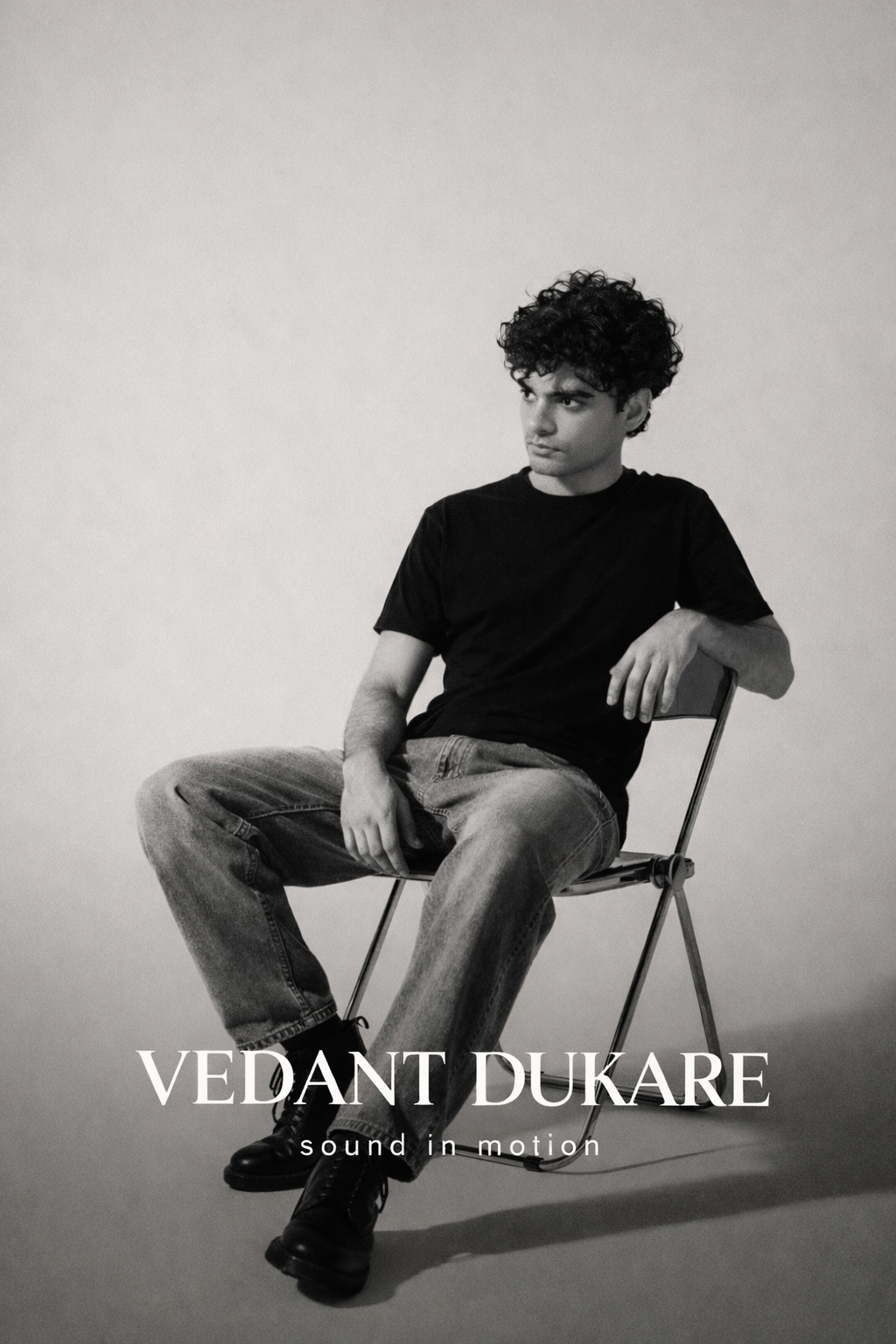
From singing in hostel rooms to learning how to reach unfamiliar listeners, the Mumbai-based artist is discovering what it takes to make himself heard.
Two days before a maths examination, Vedant Dukare was working on a different kind of problem: how to turn the sounds in his head into a song.
He was in the middle of his final school examinations and had begun exploring FL Studio. There was no MIDI keyboard. Instead, he played notes on his laptop keyboard, experimented with beats and chords, and assembled what would become his debut single, “Nobody Like This.”
“I didn’t have a proper plan or any idea where it would take me,” he tells Indie Music Bus. “I just wanted to see what would happen when I put my own music out into the world.”
That curiosity had an earlier, more personal beginning. Before he understood production or imagined a music career, Dukare recorded a cover to share on YouTube or with friends. At school, where he struggled with friendships and fitting in, singing gave him something he could contribute.
He became the person who could sing. That recognition mattered.
“I didn’t really start making music because I wanted to become an artist,” he says. “I started because I wanted to be heard.”
When Dukare later moved to Mumbai for college, he arrived with excitement and little understanding of how to find his way into its music community. On India’s western coast, facing the Arabian Sea, Mumbai is a major center of entertainment, commerce, and cultural life. Its waterfront and skyline offer a striking setting for a young artist’s ambitions. Finding a place within that city, however, was something he had to learn gradually. Maharashtra Tourism
For the first few months, he recalls feeling unsure where to go or what to do. Meeting a group of musicians helped. So did singing for the people already around him.
“I used to sing in the corners of hostel rooms, where my hostellers and friends were my audience.”
A friend encouraged him to take those performances beyond the room. Dukare began looking for gigs and remembers his first booking being in Alibaug, a coastal town in Maharashtra’s Raigad district. The area is known for its Arabian Sea shoreline and Kolaba Fort, which stands offshore and can be reached at low tide. It places this early chapter of his performing life within the wider coastal region surrounding Mumbai. Maharashtra Tourism
His account of those early performances moves from hostel rooms to small cafés, larger restaurants, and eventually festivals and other occasions. Each setting brought a different response.
He soon understood that an unfamiliar audience would not necessarily give him the attention people bring to a concert by an artist they already love.
“As an independent artist, you are not just performing for an audience, you are also building that audience.”
That realization encouraged him to include more original songs in his performances. The experience also came with difficult lessons. He says some early gigs were unpaid, and at others payment was refused after he performed. When bookings later slowed, he continued working on his music while learning the importance of relationships and patience.
Much of his recording education followed a similarly practical path. Dukare says he initially assumed that making music meant paying someone else to handle the work. Without the money to do that, he began teaching himself composition and production. His parents bought him a piano, supporting a process otherwise built around experimentation.
His early listening included Justin Bieber, Taylor Swift, and Ed Sheeran. Those influences helped shape his first English-language work. Over time, writing in Hindi began to feel more natural and personal.
“Tujhse He,” his first Hindi song, grew from feelings he could not bring himself to express to someone he liked. He searched for music that matched the experience of having so much to say and being unable to say it. Eventually, he began writing his own.
The arrangement took time to find its direction. An early version leaned toward indie rock, with electric guitar and a more forceful backing. As he worked on the lyrics, he felt the music needed to become quieter.
“The idea was to let the lyrics and emotions come forward rather than having the instruments dominate the song.”
His willingness to change the arrangement says something about how he is developing as a songwriter. Learning the tools gave him a way to make a recording. Learning when to pull those tools back helped him get closer to the feeling he wanted to convey.
Reaching listeners has presented another learning curve.
Dukare describes a period when he felt his work was improving while his listener numbers were falling. He also began to recognize that supportive comments from friends and relatives did not necessarily tell him who would seek out his music independently.
He responded by making covers, releasing more songs, and creating short-form videos around his music. He is still working out what connects. Concerts and festivals interest him partly because someone can arrive for another performer and encounter an artist they would never have searched for.
Online performance remains an area he is exploring. He has tried YouTube livestreams and uses Instagram Live to interact with listeners and share his studio process, but says he has not yet developed a structured online concert format.
For listeners who do not understand Hindi, he is interested in explaining the stories and meanings behind his songs through videos and other content. He believes people can enjoy music without understanding every word, while recognizing that context can deepen that connection.
IMB Perspective: A Way Into the Song
You don’t have to understand every word to find something meaningful in a song. A voice, a melody, or a quiet moment can invite you in. Learning what prompted the artist to write it gives you another way to connect. For Vedant, sharing those stories alongside performances could help unfamiliar listeners find their own place in his music.
“If someone understands why the song was written and what the lyrics actually mean, they might connect with it on a completely different level.”
One listener’s response has stayed with him. Dukare recalls someone discovering “Ikshana Kadhe” through a reel and telling him that the song brought a sense of calm during a difficult period. The listener said she returned to it regularly.
For an artist still learning how to find his audience, that was a meaningful encounter. Someone beyond his immediate circle had discovered a song and found a reason to keep it close.
Years earlier, singing had helped Dukare find a place among the people around him. Now, through songs made largely by his own hands, he is beginning to hear what happens when that music finds a place in someone else’s life.
Listen to Vedant Dukare

Start with “Tujhse He,” the song that grew from feelings he struggled to put into conversation. Explore his music and learn more about his work through the links below.
Listen to “Tujhse He” on Spotify · Visit Vedant’s electronic press kit
A Few More Questions with Vedant Dukare
Responses edited for length and clarity.
Have you tried or considered livestream performances? Which platforms interest you?
Vedant
I’ve tried doing livestreams on YouTube, but honestly, I haven’t discovered much about the other platforms that host livestream performances. I would need to understand that type of format and what goes beyond that.
I usually use Instagram Live to interact with fans, show them how things go in a studio, or share the process, but not for online concerts that have a strong format to them.
How would you help listeners who don’t understand Hindi connect with your songs?
Vedant
I would actually love to explain my songs in their own native language, if possible. People always say that music has no language barriers, and I do believe that. If a song sounds nice, people can enjoy it even without understanding every word.
But I also feel that knowing the meaning can make the song even more beautiful. If someone understands why the song was written and what the lyrics actually mean, they might connect with it on a completely different level.
I’d love to explain the song in a language they understand, especially through YouTube or short-form content and reels that explain more about the song and its meaning.
What have you changed about how you promote your music?
Vedant
Earlier, I was mostly focusing on making the music better and then just putting it out there. I thought that if the song was good enough, people would automatically find it. But after seeing my listeners going down, I understood that promotion is also a very important part of being an independent artist.
I started looking at my audience more carefully and trying to understand who was actually listening to me, rather than just looking at likes and comments. I also started making covers and releasing more songs because that helped me reach people who might not have discovered my original music otherwise.
I started putting more content around my songs through short-form videos instead of just releasing the song and expecting people to find it.
I’m still figuring out what works and what doesn’t, but now I understand that making the song is only one part of it. You also have to think about how people are going to discover it.