
Song Story
West Texas Grit: 3 AM Ledger (01)
West Texas Grit / 3 AM Ledger 01
From Indie Music Bus
At 3:00 AM, a deserted West Texas highway becomes a transmission line. “3 AM Ledger (01)” opens Stephen Elder’s 20-chapter audiovisual rock opera, 3 AM Static, with Industrial Cyberpunk pressure, heavy metal weight, and a voice that begins inside the machinery before revealing the person pushing through it. Written and production-directed by West Texas Grit through an AI-assisted process, the track turns static into testimony while familiar asphalt, analog instruments, and desert darkness begin slipping into something colder and constructed. This is the first entry in a record built to survive.
In the artist's own words
Why this song matters
Hello, world. My name is Stephen Elder, and I am the artist & architect behind West Texas Grit. I was born and raised in Midland, TX, right in the beating heart of the Permian Basin oil district. Been here my whole life except for a couple of years spent out east in Bensalem, Pennsylvania, a small Philly suburb close to the Jersey border where I went to Lanop computer training school. Other than that, this dusty stretch of West Texas has always been my home.
The music sets the pulse, the art frames the walls, but the stories are the absolute heart of the machine.
West Texas Grit
The full story
A fictional song story inspired by Stephen Elder’s visual Canvas for Chapter 01 and the submitted song and video materials.
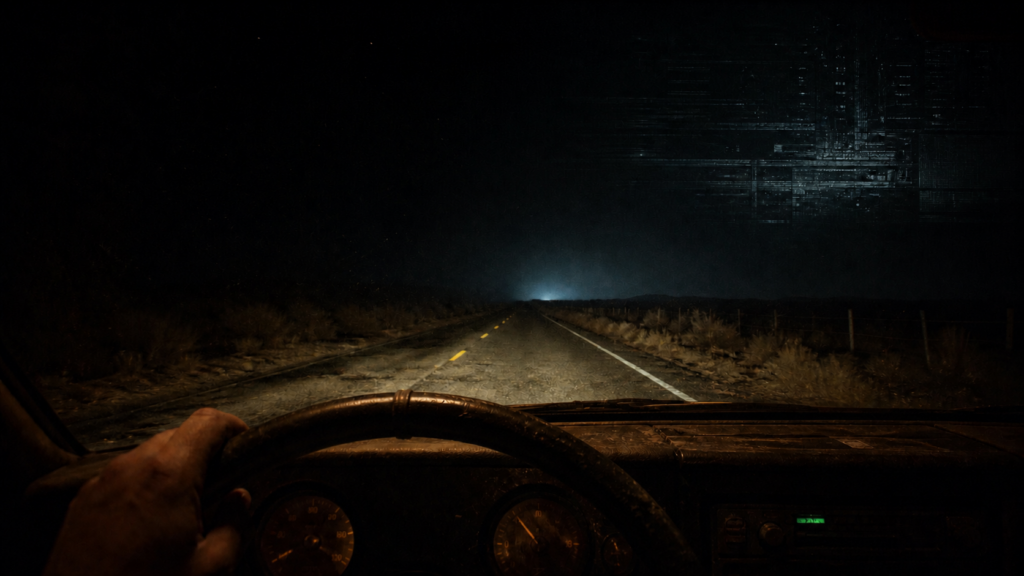
At three in the morning, the West Texas highway belongs to whatever can survive without being seen. The Observer holds the wheel steady, his right thumb working a split in the vinyl. The headlights push a shallow cone through the desert, warming the coarse pavement to the color of old dust before the road vanishes beneath the hood.
White paint slips along the right shoulder. A broken yellow line rises from the darkness, reaches the windshield, and falls away. Beyond the headlights, there is no horizon and no landmark, although a cold silver glow has begun gathering where the road should disappear.
The dashboard gives the cab its only color. Amber numbers glow behind scratched plastic, and a green needle trembles low on the radio dial. The speaker has been hissing for several miles, nothing unusual this far from town, where one station weakens before another is ready to take its place.
Then the noise begins to repeat. The crackle tightens, disappears beneath the tires, and returns with the spacing of the road lines. A rhythm rises under it and breaks apart. Two words remain in the interference: “quiet hour.”
A voice enters without introduction. Its timing is rigid and its edges flattened, less like a person speaking than a machine testing whether language can pass through metal. The Observer turns the volume down, but the voice remains inside the dashboard glow and the vibration of the steering column.
The fragments sound like observations, not a confession. They mark the hour before daylight, when darkness has stopped changing and the world has not yet begun explaining itself. The voice reports pressure and concealment. It asks nothing of the Observer; it simply continues while the highway feeds another mile beneath the vehicle.
The static is keeping records.
A clump of scrub flashes silver at the edge of the beam, followed by fence wire and a tumbleweed caught against it. Each object appears and is gone. The reception opens long enough for “on the ledge” to reach the cab before the rest of the line tears away.
The radio does not describe what passes through the headlights, but its cadence gives each thing weight. Asphalt, wire, dust, bone, breath: the ledger accepts whatever the beam uncovers.
The Observer’s reflection gathers faintly in the windshield. For an instant the face looks younger, thinned by glass and dashboard light into a school-age shadow. An oncoming rise tips the headlights downward, the reflection breaks, and the cab belongs to the present again.
Something else remains in the glass. High in the upper-right darkness, several pale right angles have formed where no structure should be, too regular for cloud and too still for reflection. They vanish when the road levels, then return farther ahead, as if the night is being assembled one black panel at a time.
The voice grows heavier as its rhythm locks to the tires. The engine answers through the floor and seat frame. Lane markings arrive at fixed intervals, fence posts repeat beyond the shoulder, and the transmission seems less like a broadcast now than a mechanism extending through the road.
For several miles, the headlights reveal less rather than more. Dust hangs above the pavement and turns the beams solid, enclosing the vehicle in two pale tunnels. The Observer can see the road immediately ahead, but not where it bends. His elbow brushes the door, and the cab suddenly feels measured to the width of his body.
Beneath the voice’s mechanical discipline, something shifts. An uneven breath comes through, followed by a roughened syllable. It could be distortion, but the Observer stops searching the dial for a station name.
The voice is not giving him a location; it is proving that someone is there.
The road opens without growing lighter. A repaired seam runs along the lane, and wind has combed dust into shallow ribs beside the shoulder. A utility pole rises beyond the glass, its wire catching the dashboard’s amber reflection before both disappear behind him.
Beyond the pole, a pale disc lifts above the low ridge. Another, smaller and dimmer, hangs farther left. Neither moves against the windshield, and both remain when the Observer blinks. Above them, the faint right angles gather into a larger geometry that is not quite a ceiling and no longer resembles a sky.
Steel remains in the transmission, along with pressure, gears, and the cost of carrying a body through systems that recognize function more readily than feeling. Near its crest, “walk out” crosses the speaker intact while the words around it collapse into grit.
What first sounded like machinery speaking is a person using machinery to be heard.
The Observer’s thumb leaves the split in the wheel. His fingers loosen, though the vehicle holds the same narrow course. Ahead, the broken yellow line continues its patient arrival, one section at a time. The steel frame still surrounds him, the radio still trembles with interference, and the voice has crossed both without losing its human shape.
The cold geometry above the road sharpens for a moment, revealing depth where open darkness should be. The horizon glow touches its lower edge, and the yellow line gives a brief sideways shiver in the windshield, as though road, signal, and structure belong to one system. Then the pattern withdraws until it can almost be mistaken for night again.
The transmission thins. Ordinary radio noise begins to reclaim the cab, but a low current remains beneath the engine and tires. The Observer keeps listening as the two pale discs hold their impossible positions beyond the ridge.
He continues west beneath a sky that may no longer be a sky, following the yellow line beyond the beam as it carries the first entry in a ledger that has only begun.
Story details
- Release date
- 2026-05-01
- Credits
- Stephen Elder AI-Assisted