
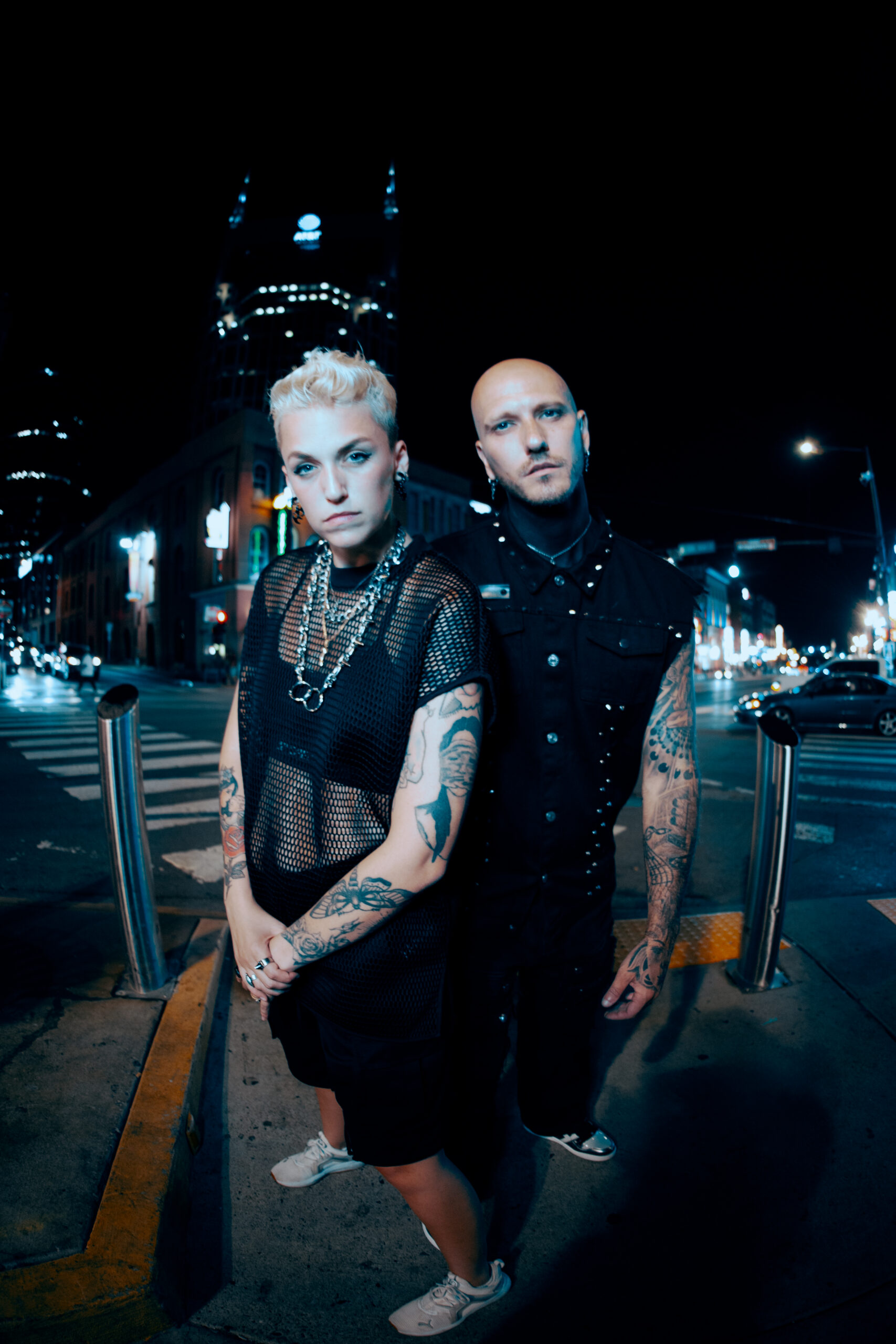
When I asked April and Jacob how they work through different creative instincts, April gave me a list of songs she had doubted. Jacob pushed for “GIRLS JUST WANNA.” She thought releasing “EVERYTHING FEELS WRONG” was a bad idea, though she now calls it MAIASAURA’s second most popular track. She thought “BITE THE BULLET” was weak, too. That one brought them their first Spotify editorial playlist placement, she says.
“So Jacob was right about those, and I was wrong,” April told me. “I am GRATEFUL his instinct steered us in the right direction!”
April gave me a less peaceful account of collaboration: “We generally disagree about 85% of what we work on, and it’s hilarious. It is war in the writing room!”
The number may be a joke, but I did not take the disagreement as a throwaway line. It helps me understand why MAIASAURA is a project both artists had to build, rather than one person inviting the other in. Their second album, NASHVILLE’S BIGGEST NU METAL BAND, arrived November 6 with a title that pokes fun at industry status. April wanted the recordings to feel more like a live band. I wanted to know how two artists with different instincts reached that shared sound.
A solo record that needed another name
I wrote about April Rose Gabrielli in 2023, when I was following her work through bands, songwriting, production and her solo releases. Jacob Kulick was part of that creative history. This time, I wanted to hear from both of them about what changed when they put a band name around work they could claim equally.
MAIASAURA did not begin with a decision to start a band. April says they were writing what was supposed to be her second solo record. She wanted to move toward heavier guitars and the rock music she considered her roots. Some earlier pop songs had been an experiment, she says, but she felt as though she was “squeezing myself into the songs rather than creating music that let me really be me.”
Then the two found a riff-driven sound that changed the ownership question. “It absolutely needed HIM to have an equal share in the creative process and the identity,” April says of Jacob. “It didn’t make any sense to call it my own because it wouldn’t be the same without him!”
Their friends and family liked what they were making, and eventually the pair needed a name. While watching Life on Our Planet, they heard Morgan Freeman introduce the Maiasaura and liked both the sound of the word and its meaning. The name now does two jobs. It identifies the band, and the dinosaur’s association with parental care gives them a language for their listeners: a family, or a nest.
When I asked why they called their 2025 debut YEAR ONE, April and Jacob gave me both the concept and the exhausted human answer. It was the band’s first year, and the record imagined an ending world in need of a reset. By the time they finished it, they were tired enough to stop searching for a more elaborate title. What interests me more is what the title did not mean. “We generally don’t feel like we’ve left anything behind,” they say. “It all gets to coexist and grow into something bigger as the years go on.”
That matters to me because I already knew part of April’s earlier story. MAIASAURA does not ask me to forget her solo work or Jacob’s. I hear them describing a place where those years, and their production partnership called The Pear, can continue together.
War in the writing room
I asked who takes the lead on a song. April could not give me a neat chart. The person who brings in the first idea may lead its foundation, but then, she says, the process becomes “a free-for-all.” She tends to work from how a track feels. Jacob, in her description, has a technical precision that gives it a distinctive shape. She credits his ability to play across instruments, produce and interpret what she is trying to describe.
“I think the tension in the room and each of us fighting for the best thing for the song are what make them awesome and so satisfying to finish,” she says.
April calls Jacob “a hit person” and herself “a deep cut person.” When those instincts differ, they look for a middle ground. They also use reference tracks to settle questions of sound, tempo and direction. I notice the practical sense of that detail. Sometimes the way through an argument is to play the other person what you mean.
I also asked how that arrangement carries into the visual work. They develop video concepts together; Jacob usually directs, films and edits, then April gives notes before they finish an edit together. April has taken a lead on the album art, from props and staging to photography and editing. “I LOVE being in charge of the album art!” she says. I do not hear a permanent division of territory in these answers. The project seems to determine who moves first, and the other person helps decide where it goes.
For the new album, April wanted a rawer, more live-band sound. She says Jacob worked toward that with Greg Collins. The released track credits identify Collins on “CARGO NET” and “DIFFERENT THIS TIME,” among the album’s ten tracks. Andrew Webb, the drummer who plays with MAIASAURA onstage, also played on every track of this year’s record, according to the band’s interview answers. I can see how the live lineup entered their thinking about the recordings, even though the project still begins with April and Jacob.
What the second year sounds like
The title NASHVILLE’S BIGGEST NU METAL BAND sounds like a boast until the joke comes into view. The band’s press material describes a local act convinced it rules a scene that does not exist. The satire reaches online performance, inflated confidence and the pressure to keep finding ways to be noticed. After reading April and Jacob’s answers, I hear that joke alongside their very real effort to get the songs in front of people.
I asked whether the run of singles was planned around the album. April and Jacob say they have put out a song roughly every four to six weeks since January 2025 because it helped with discovery and listener engagement. They kept doing what worked. The singles from 2026 appear on the new record in a different order from their release sequence. I am interested in that change: a listener who followed each release can now encounter the songs as an album rather than a calendar of updates.
“MMM ALICE” is the song whose answer made me laugh and then wince at how close the pair were to writing it off. April woke at three in the morning with the thought that Alice was malice without its first letter. Jacob later built the track, and she returned to the note in her phone. She describes a song written from a dictator’s point of view that can also be heard as a toxic-love story. An unfinished verse and a difficult outro kept it out of YEAR ONE.
When the later release deadline arrived, the pair were exhausted. They shot the artwork on the night the song was due. April says they gave it a joking title because they thought few people would pay attention. Her Spotify pitch was equally blunt: “Just put this on an editorial playlist, thank you.”
Then SiriusXM Octane played it, with Jose Mangin introducing the song, and Spotify added it to All New Metal, according to April. What stayed with me was the lesson she drew from that response, rather than the placements themselves. “We decided we were gonna take ourselves more seriously, no matter how shitty we feel in the moment,” she says.
I see a connection between the two albums there. YEAR ONE made room for a new identity. The second record turns some of the absurdity of sustaining that identity into subject matter. To me, the jokes have more force once I know how much work sits underneath them.
Music to feel
I asked Jacob how being born hard of hearing affects the way he makes MAIASAURA’s music. His answer brought me back to the physical quality April wanted in the new record. He has long experienced music, he says, as something that must be felt as much as heard. When recording and mixing, he gravitates toward big drums, low end, forceful guitars and vocals, and explosive choruses.
“I want to FEEL the music,” he says.
He mixes and produces using ReSound hearing aids, which he says help him notice frequencies he otherwise would not. I do not want to turn that into a simple explanation for every creative choice he makes. Jacob says he tries not to let being hard of hearing define how he creates. It is part of how he experiences music, and that naturally becomes part of how he makes it.
Jacob also described what an audience can see at a show: graphics synchronized to songs, visuals that change with arrangements and, at times, lyrics on screen. Andrew Webb plays drums onstage, while Marcelo Bakos joins on bass, according to the duo. Their visual show carries a storyline through the set. I like the thought of songs born in a home studio gaining another dimension when the audience can see their force as well as hear and feel it.
A band, a label, and a pear
When I saw Grow A Pear Records in the credits, I wanted to know what kind of label it was. April gave me a direct answer: “We don’t have a label. We just own our masters, pay for everything, and do it all ourselves.”
The name grew from The Pear, their production-duo name, a pun on being a pair and on the street where they once lived. Jacob even has a pear-tree branch tattoo. April also told me she swallowed a tooth while eating a pear in first grade. That is not where I expected the label question to lead.
I take Grow A Pear Records as both a joke at the industry’s expense and a description of how they fund and control their recordings. The pair say they remain published by BMG and Sony, while MAIASAURA’s recordings and day-to-day operation are their own. They describe working with outside managers and writers who did not understand the project. The joke gave that frustration a name they could put on a release.
I was curious whether their talk of a family or nest extended beyond their own audience. MAIASAURA maintains playlists that include other heavy artists, taking free email submissions alongside music they find themselves. April and Jacob say they choose tracks they like and consider a fit, while trying to build genuine connections within a scene. “There is actually a lot of room at the top,” they say. That answer makes the nest feel practical to me: they want other artists to be heard, too.
The human part of the joke
I asked about the post that pretended to accuse MAIASAURA of being AI-generated or lip-syncing before revealing itself as promotion for a show. I read it as a joke with a sharper edge: what do we trust when so much online attention depends on a quick glance? April says she wants to make people laugh at the internet’s habits while starting a conversation about technology in performance and music-making.
She is equally clear about singing as a craft. She watches live videos for the moments where she sounds breathless or misses what she wanted to do, then practices. She says she would have less to be excited about if she were perfect every time. The band’s press release calls MAIASAURA a human act. What makes that meaningful to me is the work April and Jacob describe: disagreeing, making errors, laughing at themselves, listening again and trying to get better.
I keep returning to April’s list of songs she once doubted. Jacob heard a future in some of them that she could not yet hear. Neither needs to win every argument for the band to sound like both of them. They have made an album that jokes about being the biggest band in Nashville’s imaginary nu metal scene. The work of making the music, and finding people who care enough to return to it, is entirely serious.
Listen to NASHVILLE’S BIGGEST NU METAL BAND on Qobuz, or visit MAIASAURA’s official site to find their music and join their mailing list.
The full interview
1. Before MAIASAURA, you had already written, produced, performed, and built The Pear together while maintaining your own artist identities. What did you need MAIASAURA to become that April’s solo work, KULICK, and your production partnership could not be separately?
April: We didn’t really have any intention of starting a new project or band at all! Initially, we just began writing my second solo record, and I wanted it to be heavier and more rockin’ since that’s where my roots have always been. I enjoyed exploring the pop sound for a few songs, but ultimately, it was just an experiment. I always felt like I was squeezing myself into the songs rather than creating music that let me really be me. Eventually, Jacob and I landed on this really guitar-heavy, riff-centric sound that absolutely needed HIM to have an equal share in the creative process and the identity. So, it didn’t make any sense to call it my own because it wouldn’t be the same without him! We were more excited about this sound than we had been about anything we’d ever previously made together, and our friends and family liked it too. Eventually, we decided we needed a project/band name. We were watching “Life on Our Planet” when we heard Morgan Freeman introduce the “MAIASAURA,” and we just loved the way it sounded and the origin of its meaning.
2. Why did you call the debut album YEAR ONE? What was beginning for you, and what parts of your previous musical lives were you consciously carrying forward or leaving behind?
We named our first album YEAR ONE for a few reasons. Simply, it was the first year of MAIASAURA! The whole record was also themed around the world ending and needing a reset of some kind, so this was a very literal and straightforward way to say that. We got really silly and burnt out by the end of that first year, so we just said, F it, YEAR ONE it is. We generally don’t feel like we’ve left anything behind. It all gets to coexist and grow into something bigger as the years go on. We always carry forward what we’ve done and learned from past records. Every song and record is a huge learning experience.
3. The YEAR ONE credits show April leading production on some songs and Jacob leading it on others, while both of you write across the album. How do you decide who takes the production lead? Can you describe one moment when disagreement or a different instinct from the other person made a song better?
April: This is one of the most challenging things about making MAIASAURA songs! We actually don’t know! Whoever begins the initial idea usually takes the lead on the foundational elements that start the production track, but after that, it’s truly a free-for-all. Generally speaking, though, Jacob is in charge of bringing the song to the next level and giving it a unique identity. I generally produce based on how it “feels,” while Jacob is very technically creative and intentional with the way he works, so his execution is spot-on every time. The MAIASAURA sound simply would not exist without his ability to play every instrument, produce the hell out of these tracks, and make sense of whatever I am saying. We generally disagree about 85% of what we work on, and it’s hilarious. It is war in the writing room! I think the tension in the room and each of us fighting for the best thing for the song are what make them awesome and so satisfying to finish. I will publicly state now that Jacob really pushed for GIRLS JUST WANNA (I didn’t really think anyone was gonna get it), AND it was a bad idea to release EVERYTHING FEELS WRONG (our second most popular track). I also thought BITE THE BULLET sucked, but it got us our first editorial playlist on Spotify… So Jacob was right about those, and I was wrong. I am GRATEFUL his instinct steered us in the right direction!
4. With both of you contributing to the songwriting, production, visuals, and direction of MAIASAURA, how do you decide who leads each part of a project? When you have different creative instincts, what helps you choose the direction that best serves the song?
April: I kind of got into it in the last question, but we really don’t know. Every song and project is different. Things have naturally switched on and off between us. I’d say for NASHVILLE’S BIGGEST NU METAL BAND, I wanted a more RAW live band sound on the recordings this year, so we went that way, and Jacob executed it with Greg Collins. Usually, if we have different instincts on something, we find a middle ground until we’re both satisfied. I think that confirms that the song will be liked by a wider range of people. He’s a hit person; I am a deep cut person. So when we meet in the middle, it’s fun and special. We also utilize reference tracks to get on the same page about sound choices, tempo, and overall vibe. That will often help break up any confusion about direction. Overall, we both create the music video concepts and ideas. Jacob is usually in charge of directing, filming, and editing the music videos and content. I come in and give notes when he’s about 80% done with the edit, and we wrap it up together. I LOVE being in charge of the album art! I always have ideas for still photos or pieces of art, so it has been really nice to take the lead on creating the art this year, from getting the props and staging everything to shooting and editing it. We write tons of songs together and separately in so many different ways, and we try to share it all with each other. Some songs that weren’t intentionally written for MAIASAURA have become some of our most popular songs!
5. MMM ALICE is the latest public release I found. What is the story behind that song, and does it represent the sound or emotional direction of the November album?
MMM ALICE is a funny one for so many reasons. It definitely represents the sound and this year really well. It was written really early on and probably should’ve made it onto YEAR ONE, but a jacked-up musical outro and my inability to complete a second verse kept it in the Dropbox for the foreseeable future. The beginning of the song started when I woke up at 3 AM after a bunch of very Nashville songwriting sessions (if you know, you know). I was trying to make something “clever” and found that the name “ALICE” is basically MALICE without the M. The word MALICE is metal, so I thought, maybe it’s a match. The idea sat dormant in my notes as I wrote it down half-asleep. Then, weeks or months later, Jacob created the track (basically as it is now), and when trying to figure out some words to put over it, I found the MALICE idea in my phone notes. I basically wrote it from the perspective of a dictator being in love with bad stuff, but it also doubles as a toxic love song for people who have just… been there. The song was called MALICE until we were so burnt out and defeated the week it was due that we shot the album art the same night it was supposed to be submitted. We decided to make the title somewhat of a joke because we thought no one cared or would be paying attention. I even just gave up and put in the Spotify pitch, “Just put this on an editorial playlist, thank you.” Meanwhile, the song got on SiriusXM Octane, and Jose Mangin (literally known as the Metal Ambassador) announced the song as it made its debut (sorry, Jose, it won’t happen again). Spotify also threw it on All New Metal. It was a humbling experience, and we decided we were gonna take ourselves more seriously, no matter how shitty we feel in the moment.
6. You released new music at roughly monthly intervals from late May through September. Was that cadence planned around the album, and what did releasing songs that frequently teach you about the music or the audience? Which of the 2026 singles will appear on the album?
We’ve been releasing a single every 4–6 weeks since January 2025, and it has simply been working for us in terms of fan engagement, discovery, and attention from Spotify. We wanted to keep building on what we already had, so we continued with what was working, and it continues to pay off. All of the singles released this year will appear on the album, but in a different order than they were released.
7. Your releases carry the Grow A Pear Records name, while earlier interviews discuss The Pear and your separate publishing relationships with BMG and Sony/ATV. What is Grow A Pear Records, how does it relate to The Pear, and what does independence actually look like in the daily operation of MAIASAURA?
So basically, we are THE PEAR. That was our production company/duo name that we jokingly adopted because we lived on Pear Street at the time and are a “pair” of music producers! So anything relating to or having to do with pears is special and fun to us. Jacob even has a whole pear tree branch tattooed on his forearm. Unrelated, but I lost a tooth and swallowed it while eating a pear in the first grade. We are still published by BMG/SONY, which is fun, but we’re really on our own in all of this. Honestly, in the beginning, when we were working with different managers and writers and whatever on this project, they just didn’t seem to get it. They were also kind of just lame and soggy… respectfully. We always felt more passionate, more aggressive, more hungry, and more intense. Naturally, we are just both on volume 15/10 at all times. We were just messing around again while we were pissed about everything (seems to be a common theme here) and laughing, and one of us said something like, “Yeah, GROW A PAIR (of balls).” Then we were like, “What if we name our record label Grow A Pear Records? Just to say F you to everyone.” So we did. There is a graphic that looks like two balls made out of pears that has never been seen by the public. It was surprisingly easy to make. And essentially, by label, we don’t mean a real one. We don’t have a label. We just own our masters, pay for everything, and do it all ourselves, so we are, in essence, our own label. That title is just an ode to being hungry and aggressive about our project, and it’s pretty funny to us. We like to fuck around if you haven’t noticed.
8. MAIASAURA curates several Spotify playlists for emerging and established heavy artists. Is that part of what you mean when you describe your listeners as a family or nest? What do you listen for when deciding which artists belong in those playlists?
There is actually a lot of room at the top, and we’re big believers that if you work as a group and form good connections within your scene and as a community (not for the purposes of bolstering up your own career), then you can actually grow bigger and stronger through your collaborations, both in career growth and personally. We just throw in artists we like in the genre and new releases as much as we can catch them. We also make it free to submit to the playlists, like the good old days, so some of the tracks are also via email submissions, and we thought they were a good fit overall! Trying to help out the genre and people as much as possible. Those little wins and connections throughout your career really help keep things moving in a positive direction.
9. Public sources have named Andrew Webb and Marcelo Bakos as members of the expanded live band, while more recent posts also tag Roland Street. Who is currently involved in the live version of MAIASAURA, and how does playing with them change music that begins with the two of you in a home studio?
Andrew Webb is our drummer, both in the studio and on stage, as well as a collaborator here and there, and Marcelo joins us live on bass! They both add so much to the live show and bring it to its full potential. We have gone through a lot of different band members with this project, and these guys have definitely been a great fit, as we’ve played with them quite a bit this past year. When we wrote the first MAIASAURA record, we didn’t have any solid bandmates, so we didn’t think of the music in a live setting just yet. But this past year’s more organic and live sound on the record itself was influenced by us basically wanting Andrew to play live drums on the record with us. He played on every single track of this year’s record, and there’s no other dude for the job! I think our live show is really where we shine as an act, and you can really feel the energy and the intensity of the songs. We also have an entire visual show with all of our own video content and storyline that we weave throughout all of our songs to reinforce the larger story at play.
10. Jacob, you have spoken publicly about being born hard of hearing. How does that perspective specifically influence the way MAIASAURA records, mixes, presents its visual work, or approaches accessibility at live shows?
Jacob: I think it probably influences the music more than anything else. As you mentioned, I was born hard of hearing, so I’ve always experienced music as something that needs to be felt as much as heard. When we’re recording and mixing MAIASAURA, I naturally gravitate toward records that feel really physical and powerful. Big drums, a lot of low end, guitars and vocals that are very in your face. I think that might also be part of why I love writing big, explosive choruses. I want to FEEL the music. It doesn’t really dictate the visual side of MAIASAURA. I try not to let being hard of hearing define the way I create personally. But live, I do like having a lot of visual elements happening alongside the music. Graphics synced to songs, visuals that change with the arrangements, and sometimes lyrics on screen. It gives people another way into the songs and makes the live experience feel bigger. I also mix and produce using my ReSound hearing aids, which have honestly been a game changer for me. They help me notice otherwise non-existent frequencies that I would not notice naturally. For the most part, I try not to think of my hearing loss as a limitation. It’s just part of how I experience music, and that naturally becomes part of how I make it.
11. Your recent Instagram post jokingly staged an accusation that MAIASAURA was AI-generated or lip-syncing, then revealed itself as promotion for the Exit/In show. Why did you choose that setup, and what did the unusually strong reaction to it tell you about attention, authenticity, and promoting an independent band now?
We love satire and comedy and don’t like the internet or what social media has done to the collective consciousness, so our way of being a part of it is by making fun of it all! We’ve also been asked “what auto-tune we use in our live rig” for my vocals. This is not a contrived way of suggesting that I am the best singer in all of the land. This literally happened, and I thought it was hilarious. I used to be asked, “How long have you been singing?” or “How long have you taken vocal lessons?” Now, auto-tune gets all the fuckin credit for twenty-five years of dedicating time to a craft and passion. Auto-tune live is fine for other people and even stylistically necessary and interesting to use. I am not against it on recordings either. I prefer live vocals with minimal comping and minimal pitch and time correction using Melodyne. I don’t wanna sound like everyone else, whether that helps or hurts us. But truly, singing is my craft. I do not enjoy my craft or find meaning in it unless I am trying to get better at it. Watching live videos where I sound like shit or can’t breathe is my cue to get my shit together and practice more. If I was perfect all the time on stage, I would have nothing to be excited about. As funny as these marketing ideas are, I like to start conversations about the use of tech on stage or in the creation of songs in general because I think we are at a huge turning point as artisan culture continues to be crushed by greed and industrialization. We are very passionate about being a HUMAN act, and luckily, Ariel + Shawn from ICON FOR HIRE did not even hesitate when we asked them to roast us on the internet and make content with us to promote the show we did with them. They rock and are also not AI. Love that. Unfortunately, people don’t read captions and just glance at shit and freak out. What we thought would be a funny thing to try last year (with an OBVIOUSLY fake pregnancy announcement that literally said by the fourth word in the caption that it was fake) turned into an ongoing social experiment about the lack of attention and the complete trust people have in everything they see and read, trading it only for a lack of trust in their own opinions and skepticism. We have been molded this way for years. I don’t blame the innocent people of society, but the more we, as a collective, become aware of this phenomenon, the more we can become united again.
12. Spotify recently displayed more than 57,000 monthly listeners for MAIASAURA. From the information available to you, what has driven that growth, which songs or placements made the biggest difference, and what kind of listener response has surprised you most?
I am continually surprised by this project, and our listenership is something that I never really imagined. When we put out our first single, GIRLS JUST WANNA, the goal was just to hit 1,000 streams at some point, and then I’d be happy with that. Only two years later, and our debut record has two million streams on it. There was a lot of grassroots support early on. Anyone that we shared it with in Nashville was always willing to listen, be a fan, and come to shows. And then suddenly, in the fifth month of us releasing songs on Spotify, our song BITE THE BULLET made it onto an editorial playlist. We have no label connections, and our publishers aren’t involved with creating any connections on our behalf on Spotify, so we can only attribute it to the organic streams and listeners engaging in a meaningful way early on, and Spotify noticing it, which is pretty cool. We’ve gotten placements on ALL NEW METAL, NEW BLOOD + FRESH FINDS HEAVY, and those have been really helpful. We’ve literally had a song on NEW BLOOD for about a year, and it’s significantly helped our numbers. I am just fortunate that our Spotify stats are showing that we have repeat listeners and an active monthly listener base. We don’t take it for granted at all.