
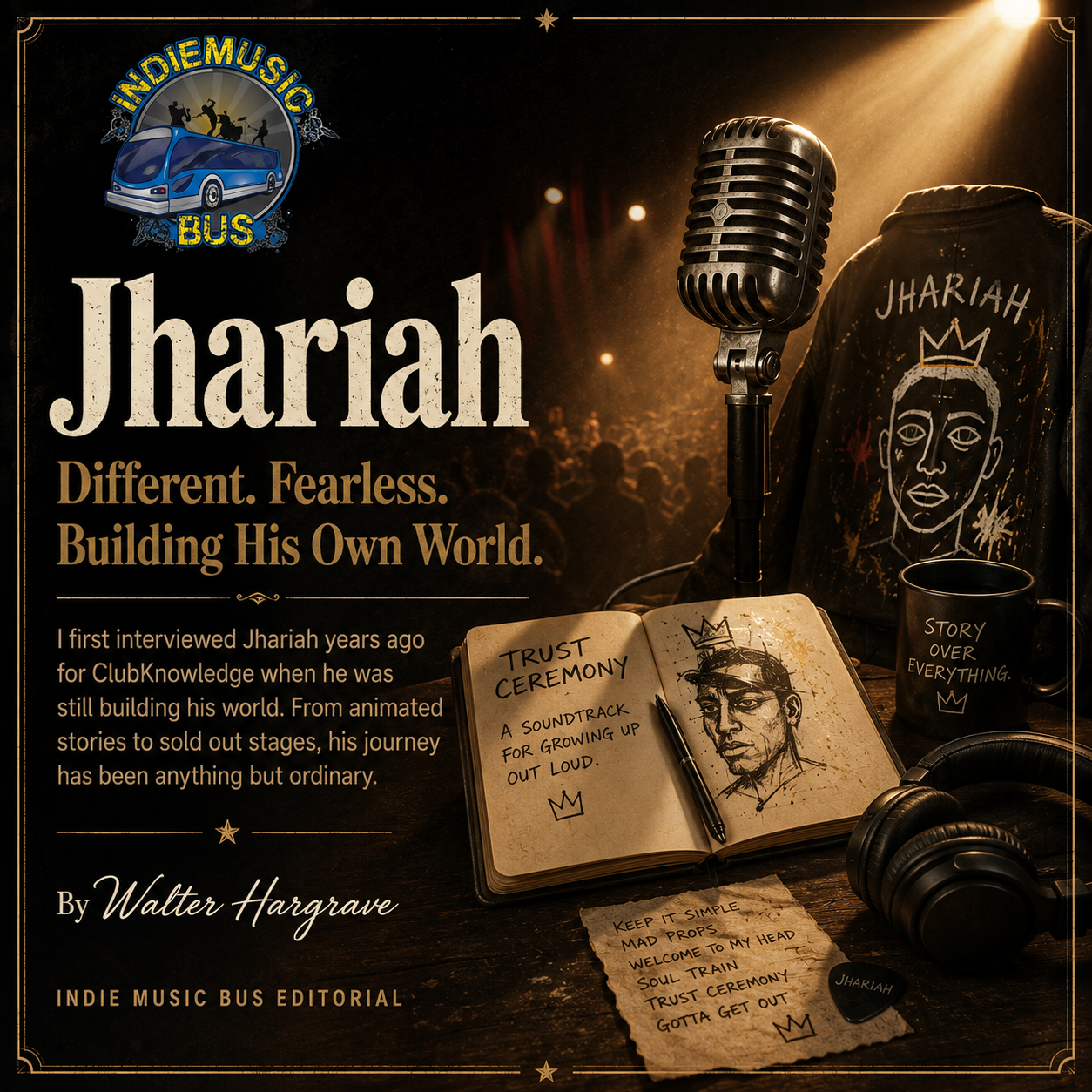
When I first interviewed Jhariah in 2020, the audience was smaller, but the scale of the imagination was already impossible to miss. Six years later, the career has grown into the vision that was there from the beginning.
When I interviewed Jhariah on June 27, 2020, I described the young artist as an animator, musician, and architect of amazing. That title was enthusiastic, but it was not an exaggeration.
At the time, To Mend the Sun was only a few months old. Live music had been interrupted by the pandemic. Jhariah was finishing a degree in 2D animation at Pratt Institute, performing with drummer and production partner Cole Raser, and trying to turn songs, illustrations, animation, theatrical instincts, and ambitious plans into one sustainable life.
The audience was much smaller then. The touring operation was smaller. The professional infrastructure that now surrounds the project had not yet been built. Still, almost everything that makes Jhariah compelling today was already visible.
The striking part of returning to that conversation is not simply how much changed. It is how much of the original architecture survived the growth.
The plan was bigger than a genre
Jhariah’s music has never been easy to file under one heading. Punk, theatrical pop, hardcore, hip-hop, jazz, electronic music, Latin dance, orchestral arrangements, and the exaggerated motion of video-game music can all appear in the same body of work. The mixture is not the point by itself.
The better description is the one Jhariah now uses: No Genre, All Drama.
That phrase describes a method. A guitar, a horn section, a dance rhythm, a sudden tempo change, or an enormous stack of vocals is chosen for the emotional job it can do. The songs move like scenes. They cut, accelerate, crowd the frame, change perspective, and sometimes stop just long enough for the meaning to land.
In a 2023 interview with Name 3 Songs, Jhariah explained that the starting point is not a decision to write within a genre. It is a question of what needs to be said and how it should be communicated. The sounds become tools selected for that purpose.
That philosophy did not appear after the audience grew. Its foundation was already present in childhood.
Jhariah told me that art came first as a serious ambition. Music developed beside it. A toy piano led to self-teaching at eight or nine years old. FL Studio arrived in middle school. By senior year of high school, an AP Studio Art requirement to create 12 connected pieces became the visual counterpart to a 12-song concept album.
Jhariah summarized that development by saying the two paths had “run parallel to each other before eventually converging.”
The resulting album, The Great Tale of How I Ruined It All, was released in 2018. Jhariah handled its production, mixing, mastering, art direction, and illustration. Live strings performed by the Fordham Prep String Ensemble appeared on two tracks. At 17, Jhariah was already operating as a songwriter, producer, engineer, visual director, and narrative architect.
That was not a collection of separate talents waiting to be organized. It was already one practice.
One medium was never going to be enough
During our 2020 conversation, Jhariah talked about discovering musical theater from both sides of the curtain. Designing and painting sets led to performing onstage. What mattered most was not any one role, but the way music, movement, acting, design, and months of collective work could become one experience.
Jhariah wanted the work to feel like “a whole experience rather than just an album.”
Animation offered a way to control more of that experience. At Pratt, Jhariah developed practical skills in storyboarding, backgrounds, compositing, and visual effects. Those skills did not become an unrelated second career. They changed how the music could be conceived, presented, and extended.
In a 2024 idobi interview, Jhariah explained that animation, film, television, cartoons, and anime helped music make sense in the first place. Music became understandable when it was connected to visual movement and story. That helps explain why so many Jhariah arrangements feel cinematic without merely imitating film scores. The visual logic exists inside the composition.
It also explains why the artwork and videos matter so much. Illustration, animation, directing, and visual effects are not decorative material added after a release. They are part of the same grammar as the songs.
The scale of that work was already demanding in 2020. Jhariah described spending months on an animated class film and more than 100 hours on post-production for a music video. The tools have developed and the audience has expanded, but the hands-on commitment remains visible in later videos connected to TRUST CEREMONY, including the self-directed and animated visual work for “FIRE4FUN.”
Ambition always had a cost
There was another idea running through the early interview that now feels just as important as the creative ambition: the physical and emotional cost of trying to realize it.
When we discussed “PRESSURE BOMB!!!!,” Jhariah described the song as a reminder to slow down, eat, sleep, and practice moderation before passion became self-neglect. The work was energized by huge ideas, but those ideas could also consume every available hour.
That tension never disappeared from the catalog. It became one of its continuing subjects.
To Mend the Sun brought pressure, burnout, vengeance, reinvention, and the need for change closer to the surface. A BEGINNER’S GUIDE TO FAKING YOUR DEATH, released in 2021, pushed further into escape, identity, guilt, overstimulation, and relentless forward motion. “Flight of the Crows” became an important route into the catalog for a much wider group of listeners.
The songs became more personal even when they still moved through heightened worlds and theatrical language. In the Name 3 Songs interview, Jhariah reflected that earlier writing could function as escape. Personal experience entered anyway, and listeners often recognized feelings inside the metaphors before Jhariah had fully acknowledged how much of the self was present.
This is why reducing the work to a clever genre blend misses the story. The changes in sound follow changes in what Jhariah is willing to confront directly.
The audience caught up with the method
The years after our first conversation brought several visible turning points.
Spotify selected Jhariah for its 2022 Fresh Finds artist-development program. The program included education, marketing support, and a creative collaboration with Henry D’Arthenay. That same year, the Bad Luck Tour was announced as Jhariah’s first full United States tour and the first with a full band.
The move from a two-person live setup to a full band was more than a change in presentation. Jhariah and Cole Raser had proved that a compact independent unit could carry complicated songs onto a stage. A full band made it possible to represent more of the arrangements’ physical force and detail, and to do so across a national touring schedule.
The growth continued without forcing the project into a simpler identity. Collaborations and shared tours placed Jhariah within a wider alternative community. “EAT YOUR FRIENDS,” created with Pinkshift, turned industry jealousy and the false idea of limited space into a statement about community. Jhariah spoke openly about how real relationships with other artists disrupted the habit of treating everyone else’s progress as a benchmark or a threat.
That matters to Indie Music Bus. An independent career is not made healthier by pretending that artists must compete for one available seat. It grows through distinct work, honest relationships, and a community willing to make room for more than one kind of success.
Trust without simplification
Jhariah’s second full-length album, TRUST CEREMONY, arrived on April 19, 2024, after roughly five years of writing. Jhariah described the record as a thesis on trust: what it means to have it, lose it, want it, and give it.
The album did not abandon speed, density, theater, or world-building. It used those elements for a more direct examination of resolve, vulnerability, self-doubt, ambition, and the danger of living so completely for an imagined future that the present becomes impossible to inhabit.
The shift is not from fiction to plain confession. It is more interesting than that. The fictional worlds remain, but they no longer provide the same emotional distance. Jhariah learned how to place more of the self inside the spectacle without giving up the spectacle’s pleasure or power.
The album’s life also shows how Jhariah thinks beyond a conventional release cycle. Instrumental and vocal editions opened the arrangements from different angles. The instrumental release invited listeners to study the production, borrow ideas, and make covers while helping fund future work. Continued visual projects and touring allowed the album’s world to keep developing instead of being discarded when the next promotional deadline arrived.
In 2026, Jhariah’s official site announced an 11-show North American headline run in support of TRUST CEREMONY. Dates across the United Kingdom and Europe are listed for October. The rooms, routes, and team have grown considerably since the two-person shows described in 2020.
The idea behind them has not changed nearly as much.
Independence as architecture
Jhariah’s career is useful because it complicates the lazy idea that independence means doing everything alone.
The project now uses specialist support for distribution, management, booking, and international touring. At the same time, the official release credits and visual work continue to place Jhariah at the creative center as writer, producer, performer, illustrator, director, or animator.
That is not isolation. It is architecture.
The important question is not whether an independent artist accepts help. It is which responsibilities must remain artist-controlled, which partnerships allow the work to grow, and whether the larger operation still serves the reason the art existed in the first place.
Jhariah’s path from a self-produced concept album to a professional international touring structure offers a strong answer. The infrastructure expanded around the authorship instead of replacing it.
What the early conversation got right
In 2020, I wrote that I believed Jhariah would have a long and fruitful career in music and the arts. That prediction was based less on numbers than on a way of thinking.
Jhariah was already connecting disciplines that other people might have treated as separate careers. Already willing to spend months learning a tool because the next idea required it. Already thinking about live performance as a complete production. Already aware that ambition could become damaging without care and moderation. Already interested in creating a real exchange with listeners instead of asking them only to stream, watch, buy, and share.
The public career that followed brought major releases, a wider audience, a full band, national tours, international dates, and a larger professional team. None of those developments explains the original difference. They reveal what happened when that difference was given time, discipline, community, and room to grow.
Jhariah was never simply an artist mixing genres.
Jhariah was building a world, and the plans for it were already there.