
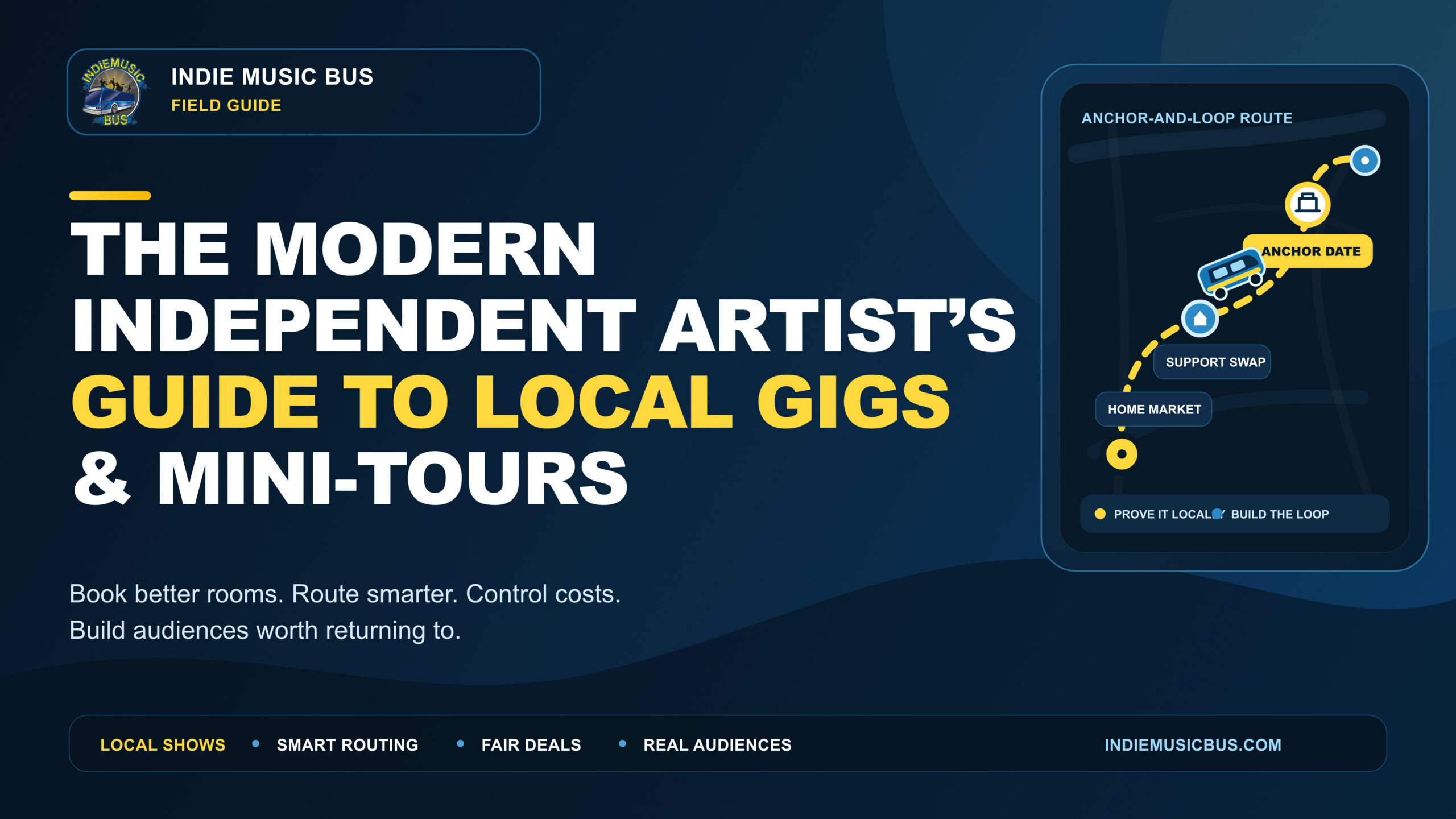
How to find the right rooms, book fair shows, route efficiently, control costs, grow real audiences, and turn every performance into future opportunity.
Playing live can still create something that streaming and social platforms cannot fully reproduce: the artist and listener sharing the same songs, in the same room, at the same time. A well-built show can generate income, deepen an audience, create useful relationships, produce lasting content, and reveal where an artist should go next.
A random collection of gigs can do the opposite. It can consume money, time, equipment, health, and goodwill without building anything durable. This guide is for independent bands and solo artists handling much of the work themselves. It begins with the local foundation and progresses toward short regional runs that can be measured, repeated, and improved.
DEFINITION
What this guide means by a mini-tour
For planning purposes, a mini-tour is a compact regional run, usually two to five public performances over two to seven days, routed around one or more strong reasons to leave home. It is not a smaller imitation of a national tour. It is a controlled market-building experiment.
A local gig is any performance that can usually be completed without overnight lodging. The exact distance depends on geography, weather, traffic, and when the show ends.
This resource is a companion to The Modern Independent Streaming Artist’s Guide. Artists can use either guide independently or combine them when recorded music and live performance support the same plan.
This is educational guidance, not legal, tax, insurance, immigration, or medical advice. Laws, contract practices, licensing rules, and tax treatment vary by location. Use qualified local professionals when a decision carries material risk.
Contents
- Start with the purpose
- Measure all five kinds of return
- Pass the live-readiness test
- Build the local gig ladder
- Choose markets from evidence
- Research rooms, promoters, and scenes
- Build relationships before asking for dates
- Prepare a booking package that reduces uncertainty
- Understand the offer
- Put material terms in writing
- Route with the Anchor-and-Loop Method
- Build a tour budget that includes the hidden costs
- Advance every show
- Promote each date as a local collaboration
- Turn attendance into a direct relationship
- Operate professionally on show day
- Protect health, hearing, people, and equipment
- Settle and document the show
- Report eligible performances and retain records
- Evaluate the result honestly
- Return strategically
- A 90-day local-to-regional plan
- Master checklists
- Official resources and update notes
1. Start with the purpose
Do not begin with a blank calendar and the instruction to “book more shows.” Begin with the result you are trying to create. A gig is a tactic. The objective determines which room, bill, deal, date, and market make sense.
| Current objective | A useful show might be | Evidence that it worked |
|---|---|---|
| Test a new lineup | A short local support set with a controlled changeover | The set runs on time; technical problems are identified; the lineup remains dependable |
| Build home-market draw | A carefully spaced shared bill or small headline experiment | More people attend specifically for the artist; direct contacts and presales improve |
| Enter a nearby city | A support slot with a compatible local act | New direct contacts, a return invitation, useful local relationships, and measurable sales |
| Support a release | A date with a real release narrative and adequate lead time | Ticket, merch, mailing-list, press, and listening activity can be connected to the event |
| Create strong live media | A room with dependable production and agreed recording access | Usable audio, video, photographs, and permissions are secured |
| Generate income | A private event, ticketed headline, guarantee, or proven merchandise market | Net contribution remains after every direct and allocated cost |
Complete a one-page show objective before accepting or pitching the date:
- Primary goal: What are we building?
- Audience: Who specifically should be in the room?
- Success threshold: What measurable result would justify the effort?
- Maximum acceptable loss: How much cash and time can the act responsibly risk?
- Next action: What happens if the show works?
- Stop condition: What would make us decline, postpone, or cancel?
FIELD RULE
A date without a next step is usually an isolated event
Before the show is announced, decide what the successful follow-up would be: a return date, a local artist exchange, a mailing-list campaign, a better support slot, a residency, or a second market connected to the first.
2. Measure all five kinds of return
A show should not be judged only by the guarantee or by how crowded one photograph appears. Independent artists can receive five distinct returns.
- Income: guarantee, door share, tips, merchandise margin, private-event leads, or future paid work.
- Audience: people who listen attentively, buy, subscribe, attend again, or bring others.
- Relationships: dependable connections with artists, promoters, venue staff, media, radio, photographers, and local supporters.
- Content: photographs, live audio, video, interviews, testimonials, and documented moments that can be used with permission.
- Information: evidence about market fit, songs, ticket prices, room size, promotion, merchandise, routing, and operating weaknesses.
A show should normally create at least two meaningful returns. One of them should point toward the next show.
Indie Music Bus field principle
A low-paying opening slot can be rational when it reaches the right listeners and establishes a dependable market relationship. A long-distance date can still be a poor decision even when the promoter calls it “great exposure” if it produces no net income, no qualified audience, no useful relationship, no reusable content, and no credible next step.
3. Pass the live-readiness test
Musical ability is only one part of readiness. A band can perform well and still be unreliable, unsafe, financially unprepared, or difficult to book. Before expanding beyond the home market, confirm the following.
Performance readiness
- The current lineup can reliably attend rehearsals, travel, and perform the proposed dates.
- The act has at least one set of the required length and can shorten it without confusion.
- Transitions, count-ins, tuning, introductions, endings, and encores have been rehearsed.
- Setup and teardown can be completed within the time normally available for the slot.
- Stage volume is controlled and the act can work with unfamiliar engineers.
- The artist can continue professionally after a mistake, technical failure, or shortened set.
Technical readiness
- Instruments, cases, stands, cables, power supplies, batteries, and critical backups are working.
- The stage plot and input list describe the current show rather than a past lineup.
- Playback systems, tracks, click, MIDI, and in-ear systems have tested failure procedures.
- Every member knows what the venue provides and what the artist must carry.
- The act can adapt to a small stage, limited inputs, a line check, or no soundcheck when those conditions were agreed in advance.
Business readiness
- One person owns booking communication and another can cover if that person becomes unavailable.
- The artist has a current website or controlled landing page, a strong live video, concise biography, photographs, music links, and contact details.
- The band has agreed how guarantees, door income, tips, merchandise, lodging, meals, and expenses are divided.
- Members understand who may accept or reject a date and what happens when someone cancels.
- The act can receive cash and electronic payments, issue an invoice when needed, and keep records.
- Merchandise inventory, prices, production costs, sales tax obligations, and settlement responsibility are understood.
Travel and safety readiness
- The vehicle is suitable, insured, maintained, and large enough to secure people and equipment.
- Drivers are named before departure and no one is expected to drive while impaired or dangerously tired.
- Emergency contacts, medications, allergies, accessibility needs, and essential health information are available to the appropriate people.
- Equipment is inventoried and identifiable; valuable items are not left visible in an unattended vehicle.
- The act has an emergency reserve that is not counted as normal tour income.
READINESS GATE
Essential failures override the score
Do not “average out” a missing insured driver, unsafe vehicle, unresolved medical need, unreliable lineup, or absent payment agreement. Those are stop conditions, not minor weaknesses.
For nonessential items, a practical threshold is nine clear yes answers out of twelve before adding unfamiliar markets. Fix the weakest operational area before adding miles.
4. Build the local gig ladder
Local development is not a waiting room before touring. It is where the artist learns to operate, establishes proof, and creates the relationships that make regional dates possible. Move up the ladder only when the current stage is producing repeatable evidence.
| Stage | Primary purpose | What to learn before moving up |
|---|---|---|
| 1. Low-risk testing | Open mics, songwriter rounds, community events, record-store sets, short showcases | Set construction, stage communication, equipment needs, timing, and which songs connect |
| 2. Compatible support slots | Perform for an unfamiliar but plausible audience | Strict set length, fast changeover, respectful bill behavior, and conversion of attention into direct connection |
| 3. Shared local bills | Co-produce an evening with complementary artists | Audience compatibility, division of promotion, ticket reporting, settlement, and collective problem-solving |
| 4. Headline or residency tests | Determine whether people attend specifically for the artist | Pricing, frequency, presales, show pacing, room size, and repeat attendance |
| 5. Nearby market exchanges | Exchange real support with an artist in another city | Honest draw expectations, local promotion, hospitality, routing, and follow-through |
| 6. Regional mini-tour | Connect proven and developmental markets in one controlled route | Budgeting, advancing, fatigue management, market comparison, and return strategy |
Space local headline dates deliberately
Playing the same market too often can divide a small audience across too many dates. The right interval depends on draw, genre, room supply, season, and whether each event gives people a distinct reason to attend. Track presales and repeat attendance rather than using a universal rule.
Treat artist exchanges as relationships, not debts
A useful exchange occurs when artists in two markets genuinely fit, communicate honestly, and each contributes locally. It is not an unconditional promise that any date must be returned regardless of room, timing, behavior, or musical compatibility. Confirm the specific expectation in writing.
5. Choose markets from evidence
A city name is not a strategy. Choose markets from evidence that the artist can reach people there or from a credible local partner who can create the first bridge. Streaming and social data can identify possibilities, but they do not equal ticket demand.
Strong market signals
- Previous paying attendees or ticket buyers.
- Direct email or text subscribers who have identified the area.
- Merchandise, Bandcamp, or direct music customers in the region.
- A dependable local artist, promoter, venue, radio host, or community organizer willing to participate.
- Repeated direct messages, replies, or listener conversations that can be tied to the market.
- Documented radio play, press, college activity, community connections, or previous private events.
- Actual presales for the proposed date.
Useful but weaker signals
- Spotify for Artists top-city and audience data.
- YouTube and website geography.
- Social followers with known locations.
- Playlist activity, saves, or repeated streams in the area.
- Similarity to a market where the artist already performs well.
Spotify for Artists currently provides top-city and audience information and explicitly positions that data as useful for touring decisions. Use it to form a hypothesis, then look for direct evidence and presales before committing major expense.
| Signal | Points |
|---|---|
| Previous paying attendees | 5 |
| Reliable local artist, promoter, or community partner | 5 |
| Direct fan contacts in or near the market | 4 |
| Direct buyers or merchandise customers | 4 |
| Relevant local radio, press, college, or organization connection | 3 |
| Meaningful streaming or video concentration | 2 |
| General social following with weak location evidence | 1 |
| No evidence beyond reputation as a “music city” | 0 |
REALITY CHECK
Do not confuse listener concentration with available ticket buyers
A city can stream the artist heavily because of passive playlists, one unusually active listener, or a demographic that rarely attends the available rooms. Streaming data is a lead. Presales, direct relationships, and previous transactions are stronger proof.
6. Research rooms, promoters, and scenes
The most important booking question is not “Does this venue host music?” It is “Does this room regularly present artists like us, at our current level, to an audience that attends for music?”
Build a venue and promoter record
- Official name, address, neighborhood, website, booking contact, and day-of-show contact.
- Capacity and practical capacity for the proposed configuration.
- Standing, seated, mixed, all-ages, age-restricted, accessible, or house-concert format.
- Recent calendar, typical genres, local artists, ticket prices, and show frequency.
- Whether the venue books directly, rents the room, or works through outside promoters.
- Stage dimensions, stairs, loading path, parking, curfew, sound limits, PA, monitors, microphones, and backline.
- Typical deal structures, documented expenses, ticketing method, fees, and settlement process.
- Merchandise location, commission, payment rules, and sales-tax responsibility.
- Evidence of active promotion and accurate event listings.
- Communication reliability, payment reputation, cancellation history, safety concerns, and accessibility details.
Review recent events, not only the About page
A venue may describe itself broadly while its last six months of programming reveal a much narrower audience. Review recent calendars, photographs, ticket pages, lineups, and artist posts. Notice whether support acts are credited, whether event information is complete, and whether the room appears to present music as a priority or as background.
Look beyond conventional venues
Depending on the act, viable rooms may include listening rooms, art spaces, community halls, colleges, record stores, libraries, galleries, houses, theaters, cafes, breweries, cultural organizations, churches, outdoor programs, private events, and temporary pop-ups. The same questions about safety, permission, accessibility, payment, sound, insurance, and audience fit still apply.
ROOM FIT
Venue capacity is not audience capacity
A 300-capacity room is not automatically better than a 70-capacity room. A smaller, well-matched, properly presented event can create stronger economics, better atmosphere, and more useful evidence than a half-empty large room.
7. Build relationships before asking for dates
Independent booking works best when the first contact is informed, specific, and connected to the local scene. Relationship-building is not artificial networking. It is learning who does reliable work, supporting compatible artists, and becoming someone other people can trust on a bill.
- Follow the venue, promoter, and relevant local artists long enough to understand what they actually present.
- Attend, buy, share, or meaningfully support local work when practical. Do not pretend to have attended an event you did not attend.
- Engage with specific music or community work rather than posting generic praise immediately before a booking request.
- Identify a realistic date range, bill concept, local partner, and reason the show belongs in that room.
- Keep notes about names, roles, prior conversations, promises, and follow-up dates.
- Return support after the show. A relationship ends quickly when the touring artist disappears after receiving the local benefit.
People who can strengthen a market
Do not limit the market map to talent buyers. Compatible artists, independent promoters, college radio, community radio, local music writers, photographers, videographers, rehearsal studios, record stores, music nonprofits, accessibility advocates, and regular concertgoers can all supply information or help create a better event. Treat their time and work as valuable.
Avoid transactional contact harvesting
Do not scrape personal addresses, add people to mailing lists without permission, or treat every public interaction as consent to receive promotion. Use public business contacts for relevant communication and provide a clear way to decline future messages.
8. Prepare a booking package that reduces uncertainty
A buyer is trying to answer a practical question: Can this act fit the room, communicate, arrive prepared, perform well, help create attendance, and complete the agreed business? The booking package should make those answers easier.
- Identity: artist name, home market, contact person, email, phone when appropriate, and website.
- Fit: one sentence that describes the live sound and plausible audience without inflated comparisons.
- Proof: one current, representative live video with clear audio and visible audience context when available.
- Music: two or three representative tracks, not an uncurated catalog dump.
- History: recent relevant shows, support credits, ticket evidence, or market results that can be verified.
- Proposal: date or range, target market, bill concept, local partner status, set length, and preferred deal structure.
- Assets: current photographs, concise biography, stage plot, input list, and approved promotional links.
Booking email template
Subject: [Artist] at [Venue] | [Proposed date or date range]

Hello [Name],

I’m writing for [Artist], an independent [specific live description] based in [City].

We are building a short regional run around [anchor date, release, or reason] and would like to discuss [specific date or range] at [Venue]. The fit appears strong because [one genuine reason based on the room, calendar, audience, or a compatible local artist].

Current live video: [link]
Music: [link]
Recent relevant show or market result: [one sentence]

[Local artist] is [confirmed / being approached] for the bill. We are seeking [clear, reasonable deal proposal], while remaining open to the structure you normally use for developing artists.

Thank you,
[Name]
[Role / Artist]
[Email]
[Phone, when appropriate]
[Website]
Follow-up
Follow up once after a reasonable interval, then once more only when there is new information or a closing deadline. Repeated “just checking in” messages do not create fit. If the date passes, update the contact record and move on without hostility.
BOOKING PRINCIPLE
Honest numbers are a professional advantage
A developing artist who accurately explains that 18 people attended the last comparable date is more useful to a buyer than an artist claiming a “large online following” with no conversion evidence. Honest data enables the room, bill, and deal to be sized correctly.
9. Understand the offer
The headline number is not the deal. Determine who carries the risk, what is deducted, who controls reporting, when payment occurs, and what the artist must provide.
| Structure | What it means | Questions to resolve |
|---|---|---|
| Flat guarantee | A fixed performance fee | Deposit? Payment method? Cancellation? Taxes or withholding? Does the fee include travel or production? |
| Guarantee plus percentage | A fixed minimum plus a share after a defined threshold | Percentage of what? Before or after taxes and fees? Which expenses? How is the threshold calculated? |
| Door split | Artist and venue/promoter divide ticket revenue | Gross or net? Who counts admissions? Which deductions? Is there a minimum? Who absorbs ticketing fees? |
| Versus deal | The artist receives the greater of a guarantee or an agreed percentage | Exact calculation, break point, expenses, capacity, comps, and settlement access |
| Support fee | A fixed amount for an opening slot | Set length, merch rights, guest list, hospitality, travel, publicity obligations, and payment timing |
| Room rental | Artist rents the space and usually carries substantial event risk | Staffing, security, production, insurance, ticketing, taxes, refunds, cleaning, damage, and cancellation |
| Ticket quota or required presale | Artist must sell or buy a defined number of tickets | Unsold-ticket liability, refunds, data access, price, fees, other artists’ quotas, and whether the arrangement is economically rational |
| Tips or donation basis | Income depends on voluntary audience payment | Who asks, who controls the container or platform, minimum support, venue share, and whether the audience expects free entertainment |
| In-kind compensation | Food, lodging, rehearsal, media, or other noncash value | Actual value, quality, availability, safety, and whether it replaces cash or supplements it |
Expenses must be named
“Seventy percent after expenses” is incomplete. Ask for the permitted expense categories, amounts or caps, supporting records, and the order of calculation. Production, security, advertising, ticketing, taxes, hospitality, staff, credit-card fees, room rental, and promoter fees should not appear unexpectedly at settlement.
Pay-to-play requires full economic analysis
A ticket quota is not automatically fraudulent, and a guarantee is not automatically fair. The question is whether the artist understands and accepts the risk. Decline arrangements that hide obligations, require misleading sales tactics, prevent refunds, or make the artist purchase inventory without a credible audience and accounting process.
THE NUMBERS
Calculate net value before accepting
Net show contribution = cash received + expected merchandise margin + reliable in-kind value − direct show costs − allocated route costs.
A $400 guarantee can be worse than a $250 support fee when the first requires extra lodging, backline rental, parking, and a long detour.
10. Put material terms in writing
Written confirmation reduces misunderstanding and creates evidence if a dispute occurs. A formal contract may be appropriate; for simpler dates, a clear deal memo or email exchange is still better than an undocumented phone call. The Musicians’ Union currently advises written confirmation of live engagements and provides standard contract resources.
- Date, venue, address, purchaser or promoter, artist, and authorized contacts.
- Compensation formula, currency, deposit, payment method, invoice requirements, and payment deadline.
- Ticket price, capacity, fees, taxes, comps, guest list, reporting, and settlement access.
- Load-in, parking, soundcheck or line check, doors, set time, set length, curfew, and changeover.
- PA, monitors, microphones, engineer, lighting, backline, stage dimensions, power, and special technical requirements.
- Hospitality, meals, water, dressing area, lodging, parking, ground transport, and accessibility.
- Merchandise location, commission, staffing, payment methods, local tax responsibility, and permitted items.
- Recording, photography, livestreaming, media access, ownership, approvals, and usage rights.
- Promotion obligations, approved billing, artwork deadlines, ticket links, and announcement timing.
- Cancellation, illness, force majeure, weather, refunds, replacement act, postponement, and deposit treatment.
- Insurance, permits, licenses, security, age restriction, conduct policy, and safeguarding requirements.
- The person authorized to change terms and the method used to document changes.
Do not announce an unconfirmed date
A conversation about availability is not a booking. Confirm the material terms and receive explicit acceptance from the authorized parties before publishing the date, selling tickets, or making nonrefundable travel commitments.
Plain-language confirmation template
This message confirms [Artist] at [Venue, full address] on [Date].

Load-in: [time and entrance]
Soundcheck/line check: [time or process]
Doors: [time]
Set: [start time and length]
Deal: [complete formula]
Deposit: [amount, due date, method]
Settlement: [time, contact, reporting]
Production provided: [list]
Artist provides: [list]
Merchandise: [location, commission, staffing, taxes]
Hospitality/lodging/parking: [terms]
Promotion and announcement: [responsibilities and timing]
Cancellation/postponement: [terms]
Recording/photo/livestream: [terms]
Day-of-show contact: [name and phone]

Please reply that you agree to these terms and identify any correction before the date is announced.
11. Route with the Anchor-and-Loop Method
Do not build a route by selecting exciting city names and then trying to fill the spaces. Begin with the strongest confirmed reason to leave home, then build an efficient loop around it.
Step 1: Secure an anchor
An anchor may be a well-matched support slot, a reliable guarantee, a festival, a release event, a proven market, a private event, a college program, or a confirmed exchange with a dependable local act. A stream count by itself is not an anchor.
Step 2: Draw the complete route
Map home to every proposed stop and back home. Include realistic load-out time, late-night conditions, weather, construction, border crossings when relevant, parking, charging or fuel stops, and the possibility that lodging is not adjacent to the venue. Avoid unnecessary backtracking.
Step 3: Give every stop a job
- Revenue date: expected to make a meaningful financial contribution.
- Audience-development date: introduces the act to qualified listeners.
- Relationship date: strengthens a valuable artist, promoter, media, or community connection.
- Content or media date: produces agreed, useful editorial or live media.
- Travel-supporting date: reduces an otherwise unproductive route segment without creating disproportionate risk.
A route composed entirely of speculative audience-development dates is fragile. Include enough confirmed income or low-cost support to protect the trip.
Step 4: Protect unscheduled time
A day without a public show is not necessarily wasted. It can be used for safe travel, sleep, laundry, equipment repair, rehearsal, a radio visit, a record-store appearance, a community conversation, or a content session. Do not add a poor-fit show solely to claim that every night is booked.
Step 5: Set route cancellation thresholds
- Loss of the anchor date.
- Presales below an agreed threshold by a defined checkpoint.
- Unsafe weather, vehicle, venue, lodging, or staffing conditions.
- Illness or injury that cannot be managed safely.
- Unresolved payment or identity concerns with a promoter.
- A budget change that exceeds the emergency reserve or maximum acceptable loss.
SAFETY GATE
Never make the overnight drive the only way the budget works
If the route requires a tired performer to drive immediately after load-out because lodging would erase the margin, the route is underfunded. Drowsy driving is a safety risk, not a badge of commitment.
12. Build a tour budget that includes the hidden costs
Tour budgeting should use net numbers and should distinguish cash flow from full economic cost. Fuel is only one part of operating a vehicle. Merchandise sales are not profit. A guarantee received weeks later does not pay tonight’s hotel.
Route-level costs
- Rehearsal, replacement players, production preparation, design, printing, tour-specific advertising, and administrative costs.
- Vehicle inspection, maintenance, rental, insurance, roadside assistance, and equipment preparation.
- Tour-specific merchandise production and packaging.
- Insurance, permits, visas, carnets, or professional advice when relevant.
- Emergency reserve and a separate method of accessing it.
Variable and per-date costs
- Mileage or vehicle allowance, fuel, charging, tolls, parking, ferries, public transit, and local transport.
- Lodging, taxes, deposits, cleaning fees, and secure parking.
- Meals, water, per diems, and dietary requirements.
- Artist, substitute, driver, engineer, crew, photographer, and contractor pay.
- Venue expenses, ticketing fees, room rental, backline, rehearsal space, production, and advertising.
- Merchandise production cost, commission, sales tax, card fees, damaged stock, and complimentary items.
- Strings, sticks, heads, reeds, batteries, cables, adapters, tape, laundry, showers, and emergency replacements.
Use a vehicle-cost benchmark carefully
For U.S. planning, the IRS standard business mileage rate can be a useful reminder that vehicle cost includes wear, depreciation, maintenance, insurance, and fuel. The rate is a tax rule, not a promise that every mile will cost exactly that amount. For travel from July 1 through December 31, 2026, the IRS rate is 76 cents per business mile. Confirm the current rate and your eligibility before using it for tax reporting.
Break-even formula
Required route revenue = total route expenses + desired artist and crew pay − confirmed non-show income.
Required average contribution per performance = required route revenue ÷ number of performances.
Worked four-date example
| Cost | Planning amount |
|---|---|
| 550 route miles × $0.76 vehicle allowance | $418 |
| Tolls and parking | $80 |
| Two lodging nights | $240 |
| Meals for four people across four days | $480 |
| Promotion and printing | $120 |
| Emergency reserve allocation | $250 |
| Total route cost before member pay | $1,588 |
| Desired member pay: four people × $100 | $400 |
| Required route revenue | $1,988 |
Assume confirmed show income totals $1,100 and expected net merchandise margin is $450. The plan is still $438 below its target. The team must improve guarantees or presales, reduce a legitimate cost, secure lodging, add reliable non-show income, or decline the route. Calling the trip “good exposure” does not close the gap.
Cash-flow schedule
Record when each deposit, guarantee, ticket settlement, and reimbursement is expected to arrive. A profitable route can still fail when the band cannot pay fuel, lodging, or a repair before the final settlement.
MERCH MATH
Budget merchandise at margin, not gross sales
A $30 shirt that cost $12 to produce and carries a 15% venue commission does not contribute $30. Before card fees and tax, its contribution is $13.50: $30 − $12 − $4.50.
13. Advance every show
Advancing is the process of confirming the operational details before arrival. Send concise information, ask specific questions, and place the final answers in a shared day sheet. Begin early enough that missing production or lodging can still be corrected.
Confirm two to three weeks before the date
- Venue address, correct loading entrance, stairs, elevator, parking, security, and equipment-storage rules.
- Load-in, soundcheck or line check, doors, set times, set lengths, curfew, and hard stop.
- Full lineup, billing order, changeover length, shared gear, and contact details.
- Stage dimensions, input capacity, microphones, stands, DI boxes, monitors, engineer, lighting, power, and backline.
- Updated stage plot, input list, playback needs, wireless frequencies when relevant, and accessibility requirements.
- Ticket link, price, fees, age restriction, capacity, presale count, guest list, and comps.
- Merchandise location, table, lighting, staffing, commission, cash rules, connectivity, and settlement.
- Guarantee or deal, deposit status, invoice, tax forms, settlement time, and authorized payment contact.
- Hospitality, water, meals, dressing area, shower, laundry, lodging, check-in, and parking.
- Photography, video, livestream, interview, and media permissions.
- Emergency contact, after-hours contact, conduct policy, security procedure, and severe-weather plan.
Reconfirm shortly before travel
Forty-eight to seventy-two hours before departure, verify that the show still exists, the contact is reachable, the address and schedule have not changed, payment details remain correct, and the ticket link is functioning. Do not wait until load-in to learn that the event moved.
Build one day sheet per date
- Date, city, venue, address, time zone, and map notes.
- Travel distance, departure time, fuel or charging plan, parking, and lodging.
- All contacts with role and phone number.
- Load-in, soundcheck, doors, sets, curfew, and settlement.
- Production summary, shared gear, merchandise terms, hospitality, and access needs.
- Deal summary, deposit status, expected payment, and unresolved items.
- Emergency information and the nearest appropriate after-hours resources identified by the team.
14. Promote each date as a local collaboration
Tour promotion should not be the same flyer posted repeatedly. The campaign must explain why this specific event matters to people in this specific place. Local artists, venue context, useful information, and direct fan contact are more persuasive than generic urgency.
The minimum event information
- Correct artist and venue names.
- City, address, date, doors, show time, and time zone when ambiguity is possible.
- Age restriction, accessibility information, seating or standing format, and relevant venue policies.
- Complete lineup and billing order when confirmed.
- Ticket price, fees, official link, refund policy source, and door availability when known.
- A concise reason to attend: release, first visit, special collaboration, residency finale, benefit, or distinctive bill.
Build a campaign in layers
- Announcement: establish the date, bill, purpose, and ticket link.
- Introduction: let each artist explain why the others belong on the bill.
- Proof: share one strong live clip, song, review excerpt, or real audience response.
- Local context: mention the room, neighborhood, local partner, radio appearance, record store, or community connection.
- Direct outreach: contact people who have opted in and are plausibly close enough to attend.
- Practical reminder: repeat doors, address, age restriction, parking or transit, accessibility, and ticket status.
- Day-of update: communicate only useful changes or final availability; do not manufacture a false sellout claim.
Keep listings synchronized
Maintain a controlled tour page on the artist’s own website and keep the venue, ticket platform, Bandsintown, Spotify, Songkick, social profiles, and calendar listings consistent. Spotify currently uses ticketing partners and Bandsintown data for live-event discovery. Bandsintown for Artists can distribute event information to Spotify and other services, and Songkick’s Tourbox allows artist teams to manage listings and ticket links. Verify each platform after publishing.
For sites that publish individual event pages, Google documents Event structured data that can make qualifying events eligible for enhanced discovery in Search and Maps. Markup must match the visible page and follow Google’s current guidelines.
Use media outreach selectively
A local writer or radio host needs a relevant story, not only a date. Pitch the artist’s connection to the market, the meaning of the release, an unusual collaboration, community work, or a strong song story. Respect lead times, format requirements, and editorial independence.
PROMOTION REALITY
Promotion cannot repair a poor event design
More posting will not solve an incompatible bill, excessive ticket price, unclear venue identity, oversaturated market, inaccessible event, or date announced too late. Fix the event before blaming the audience.
15. Turn attendance into a direct relationship
The room disappears at the end of the night. A voluntarily retained connection can continue. Give interested listeners a clear, low-friction way to find the artist again without forcing them through a single platform.
- Email or text signup with clear consent and an explanation of what will be sent.
- A simple website address or QR code leading to a mobile page with music, dates, and signup.
- Bandcamp or another direct-purchase destination.
- Merchandise that includes useful artist identification and care information.
- A printed card when connectivity is unreliable.
- A verbal invitation that is brief, specific, and does not interrupt the set repeatedly.
Do not assume the venue’s customer data belongs to the artist
Ticket-buyer information is governed by the ticketing agreement, privacy disclosures, consent, and applicable law. Ask what data will be shared before the show. Do not copy addresses from a guest list or payment record into the artist’s marketing system without a lawful basis and appropriate permission.
Measure qualified conversion
Track new signups, sales, follows, and conversations that can reasonably be attributed to the date. Ten willing subscribers who attended and remember the performance are often more valuable than a large increase in low-intent followers.
16. Operate professionally on show day
Arrival and check-in
- Arrive at the agreed time, not merely before the set.
- Check in with the named contact before unloading into restricted areas.
- Confirm schedule, production, merchandise, hospitality, guest list, and settlement changes.
- Keep vehicles, cases, and personal belongings out of exits, accessible routes, work areas, and other artists’ spaces.
Soundcheck and changeover
- Give the engineer the current input list and communicate the unusual requirement first.
- Check the elements that can actually fail; do not use limited soundcheck time as rehearsal.
- Mark settings and cable paths where appropriate, then clear the stage when asked.
- Begin teardown immediately after the set without obstructing the next artist.
- Do not alter shared equipment or another artist’s settings without permission.
During the performance
- Start and finish within the agreed window.
- Respect sound limits, curfew, venue staff, audience boundaries, and the other artists.
- Introduce the artist clearly and mention the bill, venue, and local partner accurately.
- Make one concise direct-support invitation rather than turning every transition into a sales pitch.
- Stop and seek help when a safety or medical problem occurs. The schedule is secondary.
After the set
- Move equipment to the agreed secure area.
- Staff the merchandise table or assign a trusted person.
- Thank the other artists and staff without delaying their work.
- Complete settlement before people disappear.
- Photograph or save relevant documents, collect receipts, confirm pending payments, and record any incident.
- Leave the stage, backstage, lodging, and common spaces in proper condition.
Carry a compact operations kit
The exact kit depends on the act, but common items include tested spare cables, adapters, extension cords and power distribution rated for the use, batteries, strings or other consumables, gaffer tape, basic tools, flashlight, chargers, power bank, ear protection, first-aid supplies, medication, printed contacts, backup set files, card reader, cash float, inventory sheet, markers, and weather protection.
17. Protect health, hearing, people, and equipment
Safety planning belongs in the route and budget, not in a final appendix. A show is not successful when it depends on dangerous driving, unmanaged hearing exposure, insecure lodging, harassment, inaccessible conditions, or preventable equipment loss.
Hearing
- Carry musician-appropriate hearing protection and use it consistently in loud environments.
- Work with the engineer to control stage volume and monitor levels rather than competing with them.
- Place amplifiers and monitors deliberately; avoid aiming high-level sources directly at ears when alternatives exist.
- Take quiet recovery breaks when possible and avoid unnecessary high-volume listening during travel.
- Treat persistent ringing, muffled hearing, pain, or distortion as a health concern and seek qualified evaluation.
NIOSH guidance for musicians recommends hearing-loss prevention programs and emphasizes awareness, competent sound management, and appropriate hearing protection. The risk is cumulative even when the sound is musically desirable.
Driving and fatigue
- Name drivers and maximum driving windows before departure.
- Do not assign the person who carried the heaviest performance or production load to an automatic overnight shift.
- Stop when the driver shows sleepiness, impaired attention, lane drift, repeated yawning, or missed exits.
- Do not rely on loud music, open windows, or caffeine as a substitute for adequate sleep.
- Budget lodging or a rest period when the safe alternative is not to continue.
The U.S. National Highway Traffic Safety Administration treats drowsy driving as a serious crash risk and provides prevention guidance. A routing plan that requires unsafe driving is not viable.
People and conduct
- Identify who handles harassment, threats, intoxication, unwanted access, stalking, or conflict.
- Respect consent and personal boundaries in backstage, lodging, photography, and fan interactions.
- Do not leave a vulnerable person alone with an unsafe contact or in unfamiliar lodging.
- Document material incidents and notify the proper venue, organizer, insurer, or authority when appropriate.
- Make accessibility and safeguarding requirements part of the advance, not a last-minute exception.
Equipment and data
- Maintain an inventory with serial numbers, photographs, purchase records, and ownership information.
- Use cases, labels, locks, tracking devices where lawful, and a load-out count.
- Avoid leaving equipment visible in an unattended vehicle; choose parking and lodging with security in mind.
- Back up playback files, show files, contracts, contacts, and financial records in more than one secure location.
- Limit who can access payment accounts, mailing lists, and artist administration tools.
RISK CONTROL
The emergency reserve is not a profit target
Keep it available for a repair, replacement lodging, medical need, safe transport, or route exit. Do not spend it because the final show “should cover everything.”
18. Settle and document the show
Settlement is where the agreed formula becomes a payment. Complete it before leaving whenever possible and while the authorized representative and records are still available.
- Advance tickets sold and gross revenue.
- Door tickets sold and gross revenue.
- Complimentary admissions, holds, refunds, chargebacks, and unused allocations.
- Taxes and ticketing fees, showing whether they were inside or outside the advertised price.
- Every permitted expense with amount and supporting record.
- Guarantee, percentage, break point, bonus, or support fee calculation.
- Merchandise gross, production cost tracking, commission, card fees, tax, and net received.
- Cash received, electronic payment received, payment pending, invoice number, and due date.
- Name of the person completing settlement and the artist representative who accepted it.
Simple settlement calculation
| Line | Example |
|---|---|
| 120 paid admissions × $15 | $1,800 gross |
| Less separately agreed ticket tax and platform fees | − $180 |
| Adjusted ticket revenue | $1,620 |
| Less documented production expense | − $220 |
| Net after agreed expenses | $1,400 |
| Artist share at 70% | $980 |
| Guarantee | $750 |
| Payment under a “$750 versus 70%” deal | $980 |
Save a photograph, PDF, email, or signed copy of the settlement and note any disputed or pending amount immediately. Record cash before it is divided.
19. Report eligible performances and retain records
Songwriters should not assume that performing their own work automatically produces a live-performance royalty payment. Programs, eligibility, deadlines, territories, and proof requirements differ. Keep complete setlists and follow the current instructions of the songwriter’s performing-rights organization.
- Performance date, venue, city, country, event name, promoter, and capacity when requested.
- Complete setlist with correct registered titles, writers, and work identifiers when available.
- Artist billing, set time, ticket or event link, poster, contract, settlement, and other proof.
- Whether the artist was a headliner, support act, festival act, or part of another program.
- Submission date, confirmation number, status, payment period, and any correction.
ASCAP currently provides OnStage for eligible live performances by writer members. BMI Live currently allows performing songwriters to submit recent performance information and setlists for consideration under its program. Other societies use different systems, and international performances may require additional reporting.
Keep business records
Retain contracts, invoices, deposits, settlements, ticket reports, receipts, mileage logs, lodging records, merchandise inventory, payment records, and member distributions. In the United States, the IRS states that gig workers should keep income and expense records and report income even when a tax form is not received. Use current local tax guidance for the act’s structure and location.
20. Evaluate the result honestly
Complete the post-show report while the details are fresh, ideally within forty-eight hours. Separate facts from impressions. A loud audience can be small. A quiet listening room can create strong sales and future value.
| Area | Record |
|---|---|
| Financial | Guarantee, door, tips, merch gross and margin, direct costs, route allocation, pending payment, and net contribution |
| Audience | Presales, door sales, attendance during the set, repeat attendees, direct signups, buyers, and meaningful conversations |
| Relationships | Venue, promoter, artists, media, radio, photographers, supporters, return invitation, and promises made |
| Content | Usable photographs, audio, video, quotes, permissions, files received, and editing responsibility |
| Operations | Travel accuracy, arrival, load-in, changeover, technical failures, set length, lodging, merchandise, and safety |
| Market signal | What this date now proves, what remains uncertain, and the recommended next action |
Use a five-part score
Score each return from zero to five: income, audience, relationships, content, and information. Then add one sentence explaining the score. The explanation matters more than the total. A show that scores low financially but high in qualified audience and a credible return invitation may still be strategically useful.
Run a no-blame operational review
- What worked and should become standard?
- What failed because the plan was weak?
- What failed because execution was weak?
- What changed outside the team’s control?
- Which problem could have been identified during booking or advance?
- What specific change will be tested at the next date?
POST-SHOW DISCIPLINE
Do not let photographs rewrite the result
A tightly framed image can make a weak date look full. Use ticket reports, direct sales, signups, settlement, and relationship outcomes to evaluate the show. Public promotion and internal analysis serve different purposes.
21. Return strategically
The objective is not to visit as many cities as possible once. It is to develop a smaller number of places where the artist becomes recognized, trusted, and increasingly able to draw.
- Thank the venue, promoter, artists, host, crew, photographer, media, and useful supporters specifically.
- Pay members and contractors promptly and confirm pending payments.
- Share approved photographs or clips, credit correctly, and respect usage terms.
- Send a brief follow-up containing the result relevant to that person: ticket outcome, audience response, media link, or thanks.
- Add factual notes to the market and contact records.
- Support the local artists after leaving rather than contacting them only when another date is needed.
- Wait until there is a real reason to return and enough time for demand to rebuild.
- When pitching the return, show what changed: new release, stronger partner, verified prior attendance, improved presales, or a better room.
Classify the market after the show
| Classification | Meaning | Next action |
|---|---|---|
| Develop now | Qualified audience and dependable partner evidence | Plan a stronger return within a justified interval |
| Maintain | Promising relationship but insufficient demand evidence | Stay in contact and wait for a better anchor or bill |
| Research again | The date produced conflicting or incomplete evidence | Change room, partner, timing, or offer before repeating |
| Pause | Poor fit, unsafe conduct, unreliable payment, or disproportionate cost | Document the reason and do not rush back |
| Do not return | Serious safety, fraud, harassment, or repeated material breach | Preserve evidence and protect the team |
22. A 90-day local-to-regional plan
The following plan is deliberately modest. Its purpose is to create evidence and operating discipline rather than to produce a long list of dates.
| Period | Work | Output |
|---|---|---|
| Days 1–14 | Define the live objective; audit lineup, set, equipment, website, live video, stage plot, payment, vehicle, and internal agreements | Readiness gaps, owner, deadline, and maximum show loss |
| Days 15–30 | Research ten local rooms, ten compatible artists, five promoters or community organizers, and three media or radio contacts | Ranked local relationship map and venue-fit records |
| Days 31–45 | Secure one well-matched local support or shared-bill date; confirm terms; build a specific promotion plan | One controlled local test with measurable goals |
| Days 46–55 | Advance, perform, settle, capture consent-based contacts, and complete the post-show report | Verified operating and audience evidence |
| Days 56–65 | Choose two nearby markets using the evidence score; identify local partners and route costs | Two market briefs and a provisional anchor-and-loop budget |
| Days 66–75 | Pitch a small number of specific dates; improve live proof and booking material using the local result | One anchor or strong pending opportunity |
| Days 76–85 | Confirm terms, route, lodging, safety, budget, and cancellation thresholds; do not announce prematurely | A viable two- to four-date mini-tour or a documented decision not to route |
| Days 86–90 | Publish synchronized listings and begin market-specific promotion | Accurate campaign, ticket checkpoints, advance schedule, and responsibilities |
A decision not to tour can be the correct output. If the evidence, economics, lineup, or safety plan is weak, return to local development and build the missing proof.
23. Master checklists
Before pitching a show
- Primary objective and measurable success threshold are written.
- Venue and promoter fit have been researched from recent evidence.
- A compatible bill or local partner has been considered.
- Current live video, music, biography, photographs, stage plot, and contact details are ready.
- The maximum acceptable loss and likely route cost are known.
- The proposed date does not oversaturate the home or target market.
- The person sending the pitch can answer deal and production questions.
Before accepting a show
- Purchaser, promoter, venue, and authorized contact identities are verified.
- Complete compensation formula and permitted expenses are understood.
- Load-in, set, production, merchandise, ticketing, lodging, and accessibility are workable.
- Cancellation, weather, recording, and payment timing are documented.
- The date has at least two meaningful expected returns.
- The route remains within budget and safety thresholds.
- Band members and required contractors have confirmed availability.
Before announcing
- All material terms are accepted in writing.
- Official ticket link, price, fees, date, time, address, lineup, age restriction, and accessibility details are correct.
- Venue, promoter, and artists agree on announcement timing and billing.
- The website and major event-listing destinations are ready to update together.
- Refund and postponement responsibilities are known.
- No confidential contract or personal contact information appears in artwork.
Before departure
- Every show has been reconfirmed and advanced.
- Day sheets, contacts, contracts, invoices, stage plot, and input list are available offline.
- Vehicle, insurance, roadside assistance, drivers, route, weather, lodging, parking, and emergency reserve are confirmed.
- Equipment inventory and load count are complete.
- Merchandise inventory, prices, card reader, cash float, and tax process are ready.
- Medication, food, water, ear protection, first aid, chargers, and essential backups are packed.
- Someone not traveling has the route and emergency contact plan when appropriate.
Before leaving each venue
- All people, instruments, cases, merchandise, personal items, and documents are accounted for.
- Settlement is completed or pending payment is documented with amount and deadline.
- Merchandise counts and cash are recorded.
- Receipts and incident details are saved.
- Photo, video, interview, and usage permissions are clear.
- The venue, other artists, and host have been thanked.
- The next driver is safe to drive and the lodging or route remains appropriate.
Within 48 hours after the route
- All income, expenses, member pay, contractor pay, and pending receivables are reconciled.
- Post-show reports and market classifications are complete.
- Thank-you and business follow-up messages are sent.
- Approved content is backed up and credited.
- Setlists and eligible performance reports are prepared.
- Equipment damage, vehicle maintenance, health concerns, and security incidents are addressed.
- One operating change and one market-development action are assigned.
24. Official resources and update notes
Reference links verified August 5, 2026. Platform features, tax rates, program rules, and eligibility can change. Review the current official page before relying on a specific process.
- Spotify for Artists analytics — audience, top-city, and catalog data.
- Spotify for Artists Live Events — concert listings and current integration information.
- Bandsintown for Artists: Spotify integration — current event distribution behavior.
- Songkick Tourbox event management — adding and editing artist dates and ticket links.
- Google Event structured data — requirements for event discovery eligibility.
- IRS standard mileage rates — current U.S. business-mileage information.
- IRS Gig Economy Tax Center — U.S. recordkeeping, income, expense, and filing guidance.
- ASCAP royalties and live-performance information.
- BMI Live — current performance-submission program information.
- Musicians’ Union live engagement contracts — written-term guidance and templates for applicable users.
- NIOSH: Reducing the Risk of Hearing Disorders among Musicians.
- NHTSA drowsy-driving guidance.
FINAL PRINCIPLE
The durable goal
Build fewer markets more deliberately. Use honest evidence, fair written terms, careful routing, direct audience relationships, and disciplined follow-through. The strongest mini-tour is not the one with the most pins on a map. It is the one that leaves the artist safer, better informed, financially clearer, and more welcome when they return.