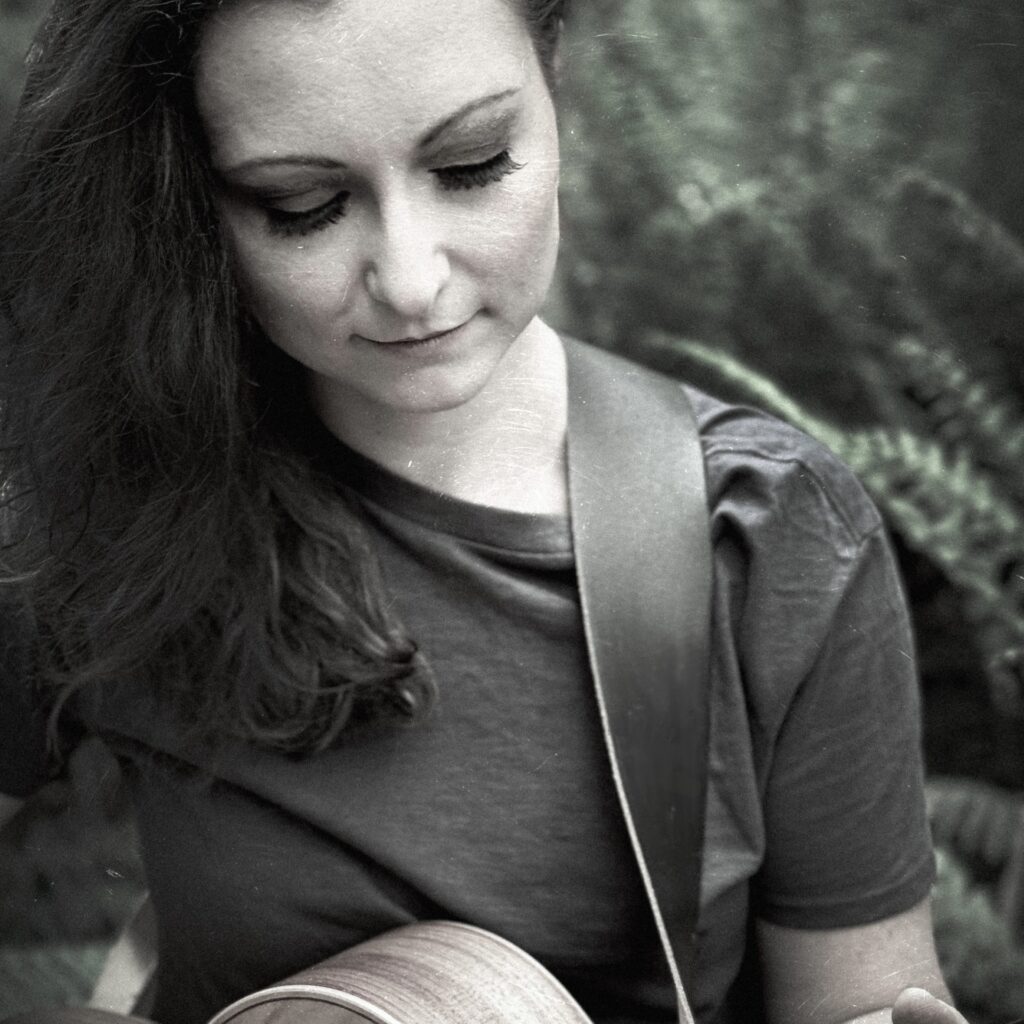
Lou Fin calls it Forest Folk: songs shaped by changing light, cold water, layered voices, and the freedom she found in Tasmania.
When I first heard Lou Fin’s “The Dawn,” I added it to the Indie Music Bus Folk collection. It did not sound like someone had chosen a genre and worked backward from there. It sounded like a place: orange light, open ground, and that private stretch of morning before most people are awake. Then dusk arrived, and the moon brought loneliness into the same landscape.
Lou calls her music Forest Folk. Her EPK describes acoustic guitar, stories, and atmospheric indie folk, but the more revealing detail is how she gives each song its own riff, color, and scene. “The Dawn” lives in warm white-orange. “Wonderful Waters” is cool black-blue. One feels like late-summer wind at daybreak. The other feels like clear, icy water below a cliff.
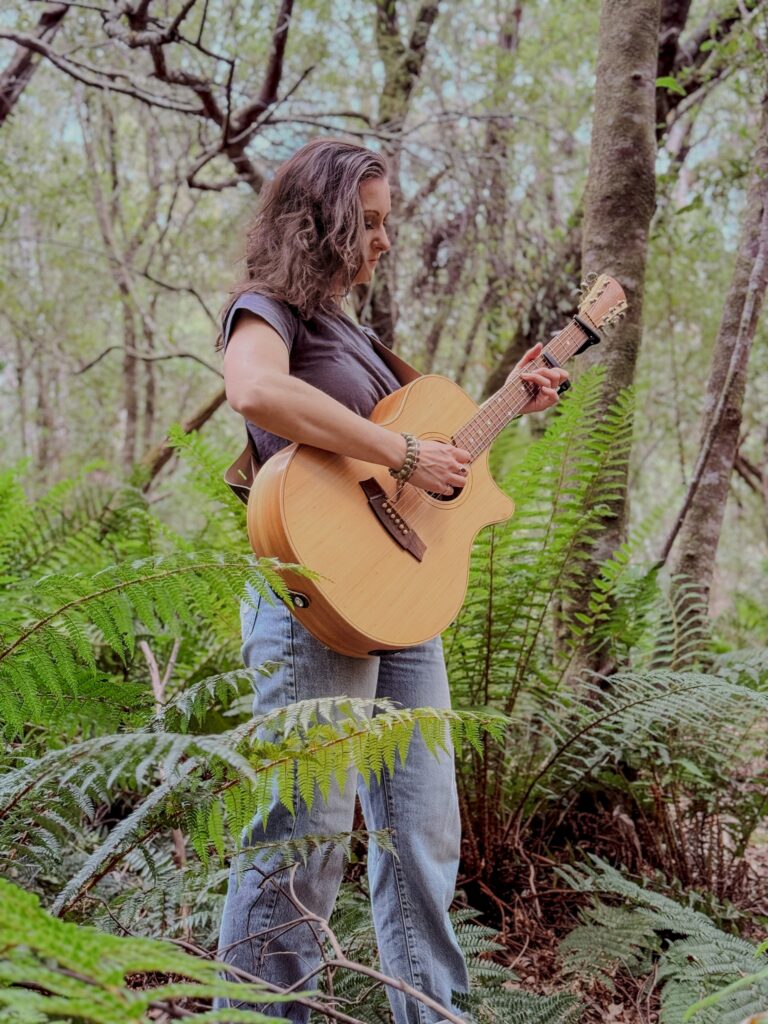
That way of thinking runs through everything she makes. The songs are not separated from their settings, artwork, or the life that produced them. Lou writes, records, and mixes her solo work herself. On her Substack, Lou Fin’s Music Musings, she writes about the stories, production choices, accidents, and images that continue to gather around the music after a track is finished. She is also one half of the folk duo Daughters of Jane. Here, though, we are following the solo path.
Other people are beginning to hear it, too. Happy Mag included “Wonderful Waters” in its New Music Radar and called it “pure mossy forest folk.” Broken 8 heard the intimacy in its acoustic guitar, restrained rhythm, and stacked vocal harmonies. Both descriptions fit, but neither tells the whole story.
Lou does that best herself.
I asked her about England and Tasmania, the colors she hears in songs, the uneasy gratitude inside “Wonderful Waters,” and why a little roughness belongs in the forest. Rather than write over her answers, I have left them in full.
In conversation with Lou Fin
Walter Hargrave: For someone hearing Lou Fin for the first time, how would you describe the music you are making now, and what does the name Forest Folk mean to you?
Lou Fin: I feel like I’m distilling inner thoughts, stories, and vibes into sound waves. I sometimes make revelations while writing, tell myself things I didn’t already know. That’s sometimes how it starts. When a song makes its way all the way through the process of writing, producing, then creating a visual world as well, and that visual world fits in the forest, that’s when it becomes Forest Folk. The idea of Forest Folk came from a particular feeling that I want to imbue a song with, solitude and safety in the wild. And a bit of escape. Being held up by the earth. It’s hard to describe. Hopefully you feel it when you listen.
Walter: Your earlier note to Indie Music Bus said that you came from England and found a home in northern Lutruwita/Tasmania. What brought you to Tasmania, and when did it begin to feel like home?
Lou: Hmm. A sense of looking for something had me leaving England. I studied and studied some more. I met my husband Allan in New Zealand and he brought me home to Tasmania. There’s a place (the Wonderful Waters pool) that has a quiet magic. Most potent when there’s light rain. Continuous running water is priceless. It felt appropriate that the WW cover should be there. I am just most at peace there. Wilderness equals freedom to me.
Walter: What differences between the landscapes, weather, sounds, or pace of life in England and Tasmania have found their way into your writing?
Lou: So different. I am positive there are places that have the same quiet magic, but I never found myself there, and wouldn’t have had a reason not to move on – or maybe I would have, who knows, that’s kind of what WW was born from. It rains a lot there so it makes sense that I gravitate towards water here and rainforest-like tree ferns and moss. The pace of life I experienced was very different there. It seemed so performative, always pretending everything is fine, always masking. I am only now learning not to mask my neurodivergent traits and that came with (traditional) working less and music-ing more. Tasmania has been (and is) my home through all of that.
Walter: You have described each story as having an accompanying riff, color, and scene. Which usually arrives first, and how do those elements begin to belong to one song?
Lou: I usually start with an idea, or an idea of an idea. Or my feet walk me to my guitar. I go searching for a riff, chord sequence or combination that fits the vibe of an idea. A lot of experimenting. But The Dawn’s idea came from a walk under an orange sky, so the scene and the feeling I wanted to capture definitely came first. Plus I was inspired by Kim Churchill’s album where all the songs were written at Dawn. He described the same feeling of freedom and solitude and I wanted to capture it. The riff for the dawn seemed to appear out of nowhere. The riff came first on Wonderful Waters, then the lyrics, production, then the visuals. I think I found my sound with The Dawn. Appropriate. Layered harmonies that several people have now said sound like strings – although there is one track of violin (pitched an octave down) in The Dawn… I love making little surprises that only happen in a song once.
Walter: “The Dawn” moves from the quiet and space of first light into the loneliness and longing of dusk. Where did that two-part idea begin, and what did you want the change in light to reveal?
Lou: The two-part idea started then I realised that my favourite parts of the day are the in-betweens. I realised they held a similar magic but one was a beginning and one and end. Or one an end and one a beginning. There’s a similar feeling of freedom to walk alone under both and that’s what ties them together. The full moon always looked lonely to me, and that folklore that the sun and moon had fallen out stuck with me, so that’s why I tried to evoke sadness in the second half of the song. That contrasted with the joy at the start, but it reveals that the cycle really has no end and no beginning. It all comes around again.
Walter: “Wonderful Waters” has a colder, more wintery atmosphere, but its story is rooted in love, choices, and good fortune. What experience or feeling did you want to preserve in that song?
Lou: It’s a feeling of bewildered gratitude that the weavings of fate brought you someone to feel bewildered gratitude for. Another cycle haha. There’s an edge of unease though because there were so many possibilities, so many turns that could have been slightly different that could have led to wildly different places. You could easily spiral into what-if this, what-if that. So Wonderful Waters is about coming back around to the gratitude, and holding onto it for dear life while you brave the chilly waters with your partner. The future can be scary, and chilly, and mysterious. That pool is magic and beautiful, and I feel at home there, so it fits the song completely. But it’s also icy cold, sometimes shoulder deep and not really that safe!
Walter: Bandcamp credits you with writing, recording, and mixing both songs. What have you learned by carrying so many parts of the process yourself, and where do you most value another person’s perspective?
Lou: I have some very talented friends who kindly give me their thoughts and encouragement. I have learned so much about the technical side, but also so little and could learn so much more. I was so happy to hit the point of being able to make something where the writing and arrangement are the focus, rather than shoddy production haha. I have also learned that production can be a really fun writing tool. The production process is where so much more can really be coaxed out of the emotional arc of the song. My favourite process is experimenting with finishing touches, the harmonies added to one word, the surprises, the ambient sounds adding atmosphere. I have so much to share! I don’t think my style is polished, but a bit rough around the edges is good enough in the forest.
Walter: If another musician asked, “What do you do?” and you could answer by playing them one Lou Fin song, which song would you choose right now, and why?
Lou: It would be The Dawn right now. If an unreleased song though, it might be Likeness With a God, which is like a musing on if I have a dark side, does God also? While sat under the stars. Either way it would be because I think they both convey strong feelings and both have a strong atmosphere, cool riffs (if I may say so) and a story arc that makes you think, if you’re so inclined.