Not Touring Does Not Remove the Work of Building an Audience
A tour is easy to recognize as work.
There are dates to book, rehearsals to schedule, routes to plan, places to sleep, equipment to move, people to coordinate, and performances to deliver. Even a short run can place a lot of jobs around the music before anyone plays the first note.
Staying home removes some of that work. It does not remove the work of building an audience.
It changes the job.
One night can do several things
A live performance can place discovery, proof, emotional connection, merchandise, networking, and direct fan contact in the same room at the same time.
Someone may arrive for another artist and hear the opening act. A listener who already knows one song may leave caring about the person who made it. Fans can talk to one another, buy something directly, meet the artist, and carry the experience into what they listen to next.
Research gives parts of that picture some weight. A peer-reviewed study using Last.fm data from 1.3 million users found that concert attendance increased subsequent listening to the performing artist among attendees. The study also found a network effect among friends of attendees for popular artists, but not for emerging artists. That limit matters. A show can create momentum, but an emerging artist cannot assume that every performance will spread through a wider network.
A 2025 systematic review of 59 live-music studies also found recurring social outcomes, including connection, shared experience, and community. Most of that evidence was qualitative, and very little of it came from controlled experiments. It supports the value of live connection without turning every concert into a guaranteed audience-building machine.
The commercial opportunity is easier to see. In a 2025 survey of 8,108 UK live-music fans, more than half said they had purchased artist merchandise at live events. The respondents were engaged venue-goers rather than the general public, so the number should not be treated as a conversion forecast for any particular artist. It still shows how naturally a show can place music, attention, and direct support together.
That concentration is difficult to reproduce when the stage is removed.
The work gets separated
Without regular live shows, an artist may use releases, videos, collaborations, community participation, direct outreach, livestreams, email, advertising, sync placements, or some combination of them.
No artist needs all of those channels. That is worth saying plainly. Trying to maintain every available platform is not a strategy. It is a good way to create a long list of jobs that never ends.
The useful question is not, “Where should an artist post?”
The useful question is, “Which audience-building job needs to be done?”
Discovery is one job. Giving a new listener a reason to stay is another. Creating a place for direct contact is another. Selling music or merchandise, developing professional relationships, and learning which efforts produce lasting attention are separate jobs too.
A live event may handle several of them in one evening. A non-touring artist has to decide which ones matter now and which channel can handle each one honestly.
The artist becomes a small media company
This is where the workload can become hard to see.
The Oxford Internet Institute and the University of Groningen surveyed roughly 1,200 musicians in Brazil, Chile, the Netherlands, Nigeria, and South Korea. Sixty-nine percent said they spend more time promoting their music online than they did a few years earlier. Almost a quarter said they spend more than half their working time on tasks such as social media, tour planning, or fan communication.
Those figures do not describe every musician or every country. They do show that promotion is not a small activity sitting beside the creative work for many of the people surveyed. It is taking up a substantial part of the working week.
Qualitative research reaches a similar concern from another direction. Research involving music producers and working musicians describes artists taking on business, technical, video, managerial, promotional, and audience-facing work. Social media can help with connection, networking, self-expression, and career development. It can also create pressure to stay visible, keep producing material, watch uncertain algorithms, and compare one career with another.
Without live shows, the artist can become a small media company built around the music. The danger is letting the company consume the artist.
Build functions, not a content treadmill
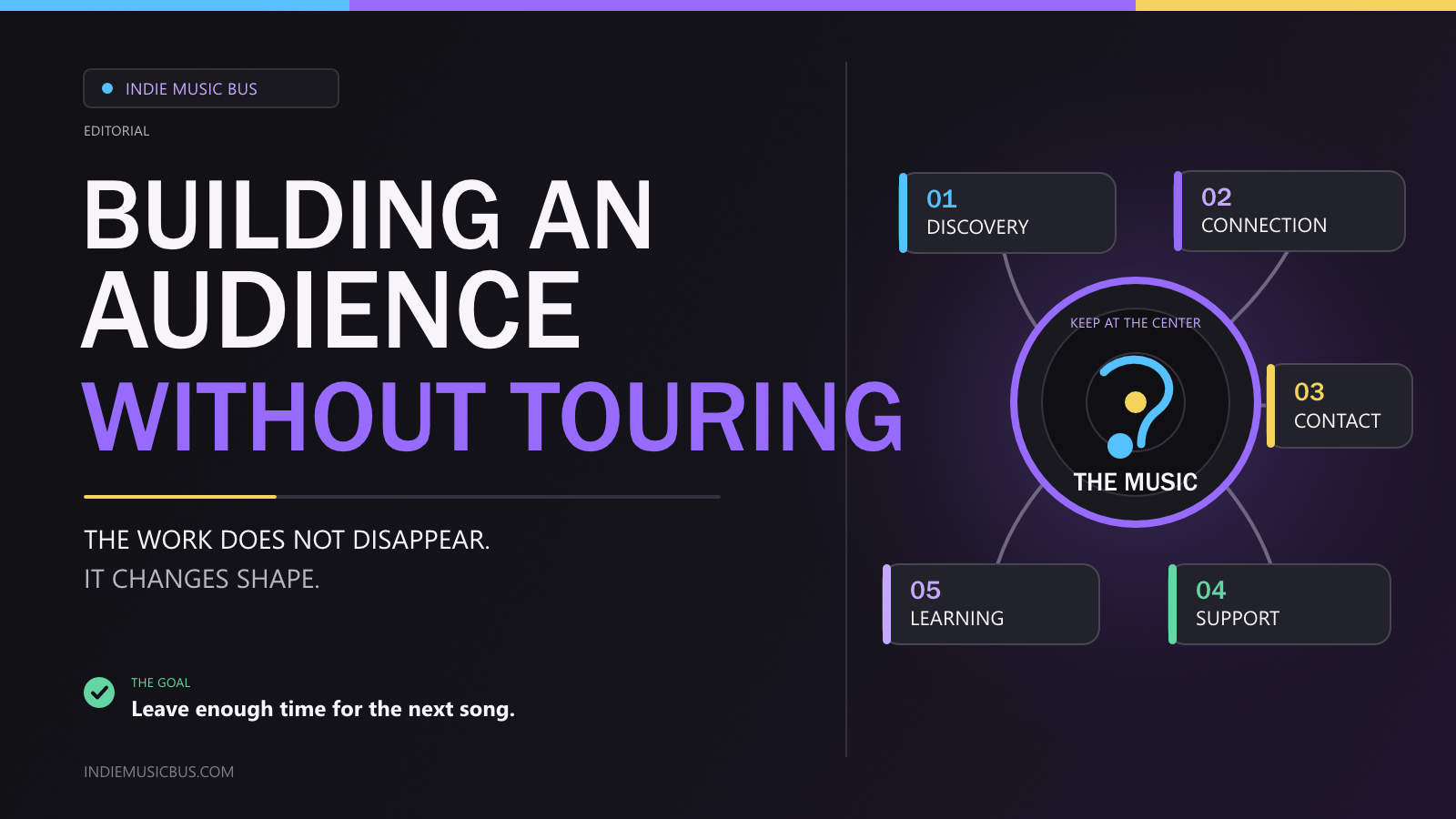
The answer is not to reproduce a tour by posting more often. It is to build the smallest system that covers the functions the artist actually needs.
That system might contain:
- One discovery route. Choose the place where a suitable listener is most likely to encounter the music. That could be a collaboration, a video format, a playlist pitch, a community, a piece of press, a sync opportunity, or selective advertising.
- One deeper encounter. Give interested listeners somewhere to hear or understand more. A complete performance video, interview, listening session, artist commentary, or livestream can do more than another short fragment when someone is already curious.
- One direct-contact route. Give people a voluntary way to hear from the artist again. Email, SMS, or a stable community can serve that purpose. A platform follow may be useful, but the platform still controls how often that connection is delivered.
- One support route. Make the next meaningful action clear. It may be buying music, ordering merchandise, joining a membership, attending a livestream, licensing a track, or sharing the work with someone else.
- One learning loop. Review what happened after a defined period. Look for returning listeners, direct sign-ups, replies, repeat participation, buyers, and useful professional relationships. Reach by itself does not show that an audience is forming.
This is not a universal formula. Different music creates different routes. A producer, a metal band, a songwriter, a DJ, and an artist working primarily in sync should not be expected to build the same system.
The point is to give each activity a job. If a channel consumes hours without bringing the artist closer to a listener, supporter, collaborator, or useful decision, it deserves to be questioned.
Protect the reason the system exists
Promotion can always expand. There is always another platform, another format, another piece of advice, and another metric waiting to be checked.
Music-making time does not expand with it.
That makes creative capacity part of the audience plan, not something to protect after the marketing calendar is full. An artist can track promotional hours alongside returning listeners, sign-ups, sales, and repeat participation. If the work required to maintain the system keeps growing while durable audience movement does not, the system needs to become smaller or change direction.
Touring is not passive. Neither is building an audience without it. The costs simply move.
The goal is not to win the content treadmill. It is to build a discovery system that leaves enough time and creative energy to make the next song.
Before you go
If you do not tour regularly, which part of audience building has been hardest to replace?
Share your experience in the comments. Subscribe to Indie Music Bus for more writing about independent music, creative work, and practical ways to keep the music at the center.
Sources and further reading
- Oxford Internet Institute, Musicians at Work in the Platform and AI Era
- Ternovski and Yasseri, Social complex contagion in music listenership
- Rickard and colleagues, The unifying power of live music events
- Music Fans’ Voice, 2025 survey results and methodology
- Ng and Gamble, Hip-hop music producers’ labour in the digital music economy
- Musgrave and colleagues, Working in the content factory