
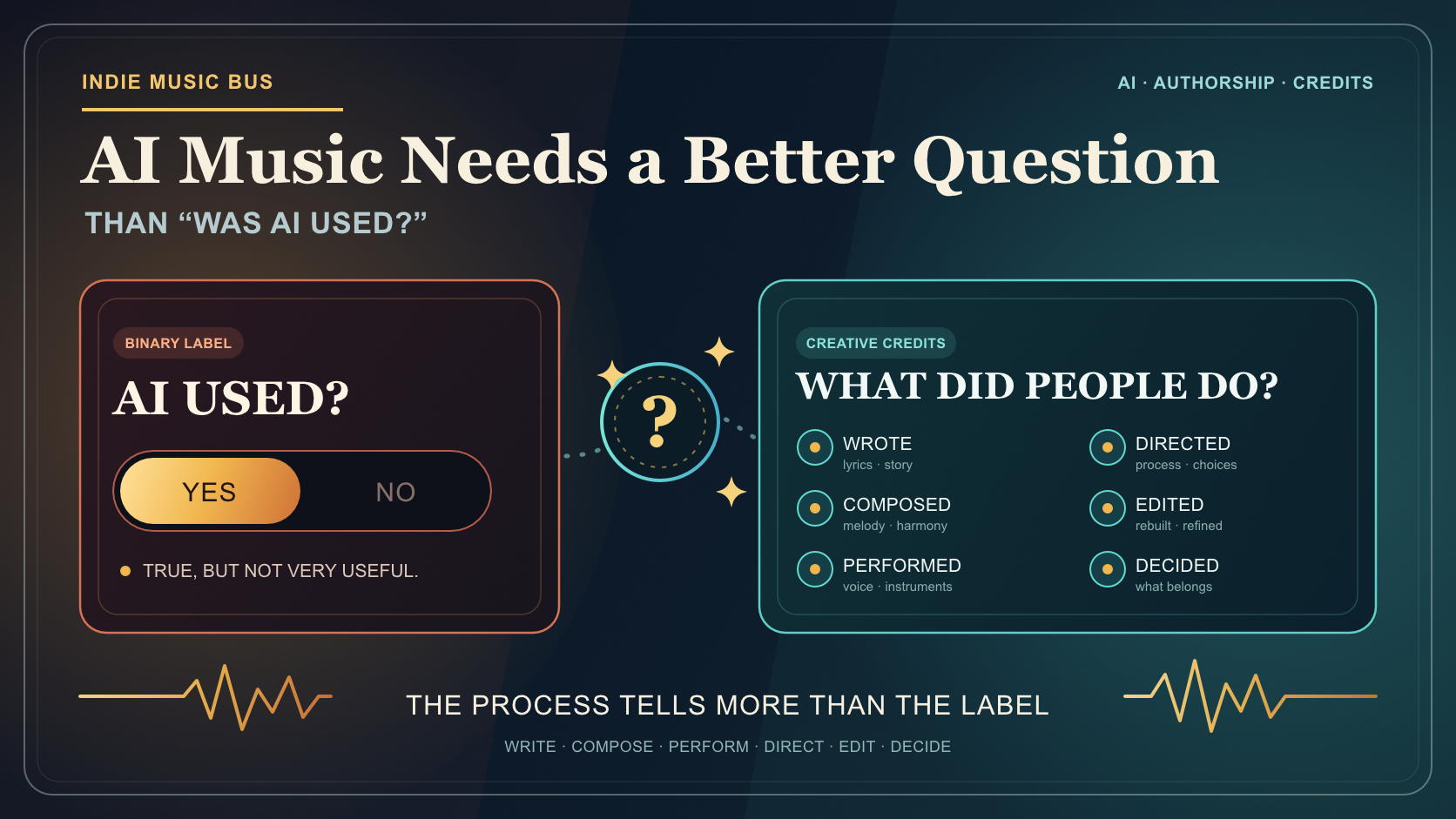
AI can play very different roles in a recording. A yes-or-no label tells us very little about what the people behind the music actually created, performed, directed or decided.
I recently wrote about the possibility that AI could make musicianship more valuable. Generated recordings may become abundant, but the years required to develop an instrument, a voice, a musical ear or the ability to perform do not suddenly become abundant with them. The responses to that article made me realize there is another part of this conversation that deserves more attention.
One response came from West Texas Grit, who described spending much of their life around recording studios, playing by ear and writing music on keyboards and drums. Their problem was never a lack of musical ideas. They could hear music internally, but they did not have the physical instrumental or vocal ability to perform all of it at the level they wanted. AI gave them another way to get those ideas out.
Their experience raises a question I think is considerably more useful than simply asking whether a song uses AI: What did the person or persons actually create?
“AI music” describes too many different things
The phrase AI music can now describe wildly different creative processes. One person might type a short description into a generator and accept the finished recording. Another might write every lyric, establish the story and structure, specify the instrumentation and repeatedly direct generations until the result comes close to what they intended.
A musician might compose a song and perform most of it while generating one instrument they cannot play. Someone else might record an entire traditional performance and use AI only during mixing or mastering. Another artist might generate a vocal, then manually construct everything surrounding it in a DAW. Calling all of this simply “AI music” removes most of the information I would actually want to know.
The music industry itself is beginning to recognize the problem. Spotify now describes AI use as a spectrum rather than a binary choice and is introducing credits intended to tell listeners where AI contributed to a recording. DistroKid already lets artists distinguish between generated lyrics, generated composition, partially generated audio and entirely generated audio, while AI-assisted mixing and mastering are treated differently again. That is much closer to the conversation I think we should be having.
Musical ideas and physical performance
Music has never required one person to physically perform everything they conceive. Songwriters write for singers, composers write for instruments they do not play, producers direct performances, and arrangers decide how other musicians will play a composition. Artists hire session musicians because somebody else possesses a physical skill they do not. A songwriter can hear a string arrangement without knowing how to play violin.
The violinist remains important because that musician contributes an ability developed through years of work. Musical conception and physical execution simply do not always exist in the same person. AI complicates that relationship enormously because using a generative system is not identical to hiring another musician.
A session musician can interpret instructions, introduce ideas, respond emotionally, disagree, improvise and bring years of individual experience into a performance. There is another person contributing to the recording, so I would not go as far as calling AI another pair of hands. West Texas Grit’s experience still exposes something important, though. Some people have musical ideas, knowledge and judgment that their physical abilities have always limited their ability to turn into a finished recording. Technology can change that boundary.
We already have a remarkable example
The U.S. Copyright Office’s examination of AI-assisted work includes an interesting music example. After Randy Travis suffered a stroke that severely affected his ability to sing, a specialized AI vocal model was used to create “Where That Came From.” James Dupré supplied the underlying performance, including its phrasing, cadence, dynamics and articulation, while the technology helped transform that performance into Travis’s distinctive vocal sound under the supervision of the creative team.
The Copyright Office treated this as AI functioning as a tool rather than generating the expressive performance itself. That process is nowhere near the same as requesting a complete song from a generator, yet both could casually be described as music made with AI. A single label hides the difference.
Authorship and musicianship are not exactly the same
Every act of directing a generator does not automatically become musicianship. There is still a difference between imagining a guitar solo and possessing the ability to play one, just as there is a difference between asking for a difficult drum performance and spending twenty years developing the coordination, timing and judgment required to perform it. Those abilities remain important, and that was a major point of my original article.
Physical instrumental ability is not the only musical ability, either. Composition, arrangement, critical listening and production are skills. Rhythmic and harmonic judgment are skills. Recognizing that a generated section is wrong, understanding why it is wrong and knowing what needs to change can involve musical knowledge even when the person making that decision cannot physically perform the corrected part.
That leaves us with a much more interesting spectrum of participation than placing a “real musician” at one end and an “AI user” at the other.
The process tells me more than the label
As somebody who listens to music and sometimes writes about it, I would rather know what happened. Who wrote the lyrics and composed the melody and harmony? Was the arrangement conceived by a person or generated? Who performed what we are hearing, and what portions of the audio were generated? Did the person substantially edit or reconstruct the generated material afterward? Were the vocals generated, or was AI used only in production, restoration, mixing or mastering?
Most importantly, I want to know which decisions belonged to the people whose names are on the music. Those answers tell me considerably more than a badge saying AI.
The industry appears to be moving toward this kind of information as well. DDEX has expanded its music metadata standards so companies can communicate whether recordings and individual contributions were created fully or partially using generative AI. Spotify has also begun displaying more specific AI contribution credits where distributors provide them. That is a much more useful direction than collapsing an increasingly complicated creative process into one checkbox.
Transparency should inform, not punish
If artists discover that honestly explaining any use of AI causes people to reject their music without listening, we create an incentive to hide it. That helps nobody and certainly does not improve trust. Spotify has specifically said its disclosure system is intended to provide transparency rather than punish responsible use or automatically down-rank music because AI involvement was disclosed.
I think that distinction matters. Transparency should tell me more about a recording without automatically telling me what opinion I am required to have about it. I can learn that someone wrote every word, developed the concept and arrangement, generated the instrumentation, then spent weeks restructuring and editing the result before deciding whether I think the song works. I can also learn that someone entered two sentences into a generator and published the first result. Those are different creative histories, and I want to know the difference.
Clearer disclosure can exist alongside firm boundaries. Unauthorized voice impersonation is a serious issue. Spotify now explicitly requires authorization for vocal impersonation on its platform, and DistroKid prohibits unauthorized imitation of another person’s voice, likeness or identity. Mass-generated material intended to manipulate streaming systems is another problem. Spotify has built additional spam controls, while DistroKid explicitly prohibits using generated music to flood services or game their systems.
Arguments surrounding training data, copyright and compensation remain unresolved, and platforms are entitled to draw their own lines. Bandcamp has drawn a particularly strong one by refusing music generated wholly or substantially by AI. Those debates are not going away, but none of them make a binary description of the creative process more informative.
Credits may become much more important
For decades we have been losing some of the detail that used to surround recorded music. An album sleeve might once have told you who played bass, who arranged the strings, who engineered the sessions, where the record was made and who produced each track. Streaming reduced much of the listener’s immediate experience to an artist name, song title and image.
Generative AI may unexpectedly give us a reason to bring detailed credits back. People deserve credit, but how a piece of music came into existence may also become part of understanding the music itself. Listeners may want to know that the singer actually sang it, that the songwriter wrote every word but generated the backing track, or that a producer created the arrangement while AI provided one instrumental part.
They may want to know that several musicians performed the recording and AI was only used in post-production, or that everything they are hearing was generated. Those distinctions give listeners the information they need to decide what matters to them.
Where I land now
My original argument has not really changed. I still think musicianship may become more valuable precisely because generated recordings can become almost unlimited while developed musical ability cannot. I would expand the argument now, because physical virtuosity is not the only contribution worth recognizing.
Some people’s musical ability exists partly in their ears, writing, arrangement decisions, production knowledge and ability to recognize when something is right or wrong. AI may allow them to realize music they previously could not physically execute themselves. That gives us another kind of human contribution to identify and judge.
A generated recording is not automatically equivalent to a performance, prompting is not the same as learning an instrument, and the musicians who spent years acquiring abilities another person does not possess still deserve recognition for those abilities. We simply need better language for describing what happened.
So perhaps the question at the end of my previous article needs an adjustment. Instead of asking only whether AI was used, I would rather ask: What did the person or persons create, write, compose, perform, direct, edit, decide and mean?
Tell me that. Then I have something meaningful to judge.